

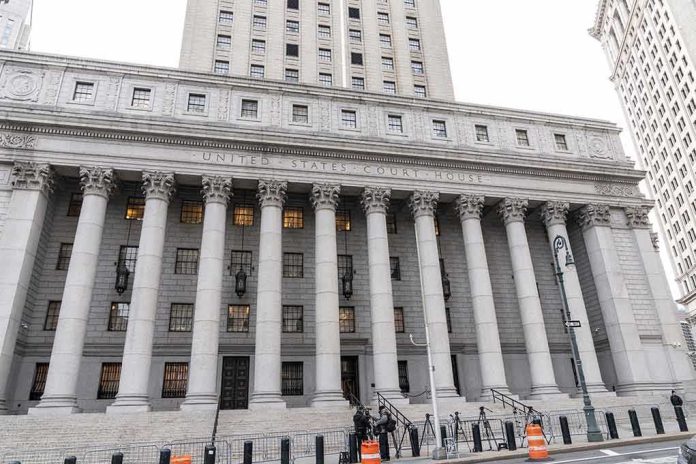
A federal judge halted ground-breaking on President Trump’s planned 250-foot arch, saying construction must pause while the court reviews whether the project has the required legal approval.
Story Snapshot
- Judge Tanya Chutkan ordered a 14-day stop to construction plans tied to the arch.
- District of Columbia and Virginia argue the project lacks specific congressional approval under the Commemorative Works Act.
- A federal planning commission still approved final plans in an 8-4 vote after hours of public comment.
- Plaintiffs also say the 250-foot height breaks statutory limits and risks irreparable harm if work starts.
What the Court Did and Why It Matters
United States District Judge Tanya Chutkan issued a 14-day order blocking construction activity tied to the arch near Memorial Circle. The order came after the District of Columbia and Virginia sought emergency relief to stop work while lawsuits proceed. The judge also required fast notice if the planning commission took action, signaling concern about rapid steps that could lock in the project before review. The order preserves the status quo while the court weighs if federal law requires fresh approval from Congress.
Lawyers for the District of Columbia and Virginia argue the Commemorative Works Act requires specific authorization from Congress for a new monument on federal land in the Washington area. They say the administration skipped that step and cannot rely on a century-old bridge law to justify a far larger structure. The plaintiffs also claim the 250-foot plan exceeds statutory height limits. The court’s temporary pause does not decide who is right, but it prevents irreversible digging while the legal issues are tested.
What the Federal Commission Approved
The National Capital Planning Commission approved final site and building plans by a vote of 8-4 after lengthy public comment. More than 100 speakers addressed the panel, many opposing the project, yet the commission still cleared it. That vote gives the administration a key approval, but it does not settle the larger question of congressional authorization or other federal laws the suits invoke. The commission’s late-night approval created urgency for challengers seeking court intervention.
Commission leaders and administration officials say Congress already acted in 1925 when it authorized the Arlington Memorial Bridge and related memorial features. They argue that the current arch fulfills that historic intent, even if the original concept called for two 166-foot columns that were never built. They also promote the arch as a national gateway honoring veterans and as a project with security value for the capital region. These claims are now central to the legal and public debate.
The Core Legal Fight Over Authority
The heart of the dispute is simple but weighty: Who must say “yes” before a giant, permanent monument rises in the nation’s capital? The suits say the Commemorative Works Act needs a new law from Congress for a project like this. The administration says a 1925 law already opened that door. The difference is not just theory. It decides whether the executive branch can push ahead now or must return to Congress for a specific green light tailored to this exact design and height.
Challengers add a height claim, saying a 250-foot arch would violate statutory limits that cap structures in the area at about 130 feet. Reporting does not yet map the exact boundaries or exceptions that could apply to Memorial Circle, so the height issue remains an allegation that the court will need to test against the text and the site plan. Either way, the judge’s pause means the government must hold off on steps that could make any later ruling harder to enforce.
Why People Across the Spectrum Care
Many Americans on the right and left see a pattern here. Major projects appear to move faster than public oversight. Agencies and commissions hold long meetings, but real decisions seem to land late at night, after most people have tuned out. Residents and veterans worry that once the digging starts, the fight is over. Courts rarely stop construction after the fact. The temporary order gives the public a window to see if the rules meant to protect shared spaces still carry weight.
TRIUMPHAL ARCH UPDATE: A federal judge blocked the Trump administration from breaking ground on the memorial arch for 14 days. https://t.co/xwaC1NFebw
— WTOP (@WTOP) November 6, 2026
The administration frames the arch as a long-delayed tribute with benefits for honor and security. Opponents frame it as an unlawful, oversized build that bypasses Congress and reshapes a sacred vista between the Lincoln Memorial and Arlington National Cemetery. The next steps are procedural but critical: filings, hearings, and a deeper look at the 1925 statute, the Commemorative Works Act, and any height laws that apply. The outcome will signal how power over Washington’s landscape is exercised and checked.
Sources:
cbsnews.com, npr.org, cnn.com, abcnews.com