

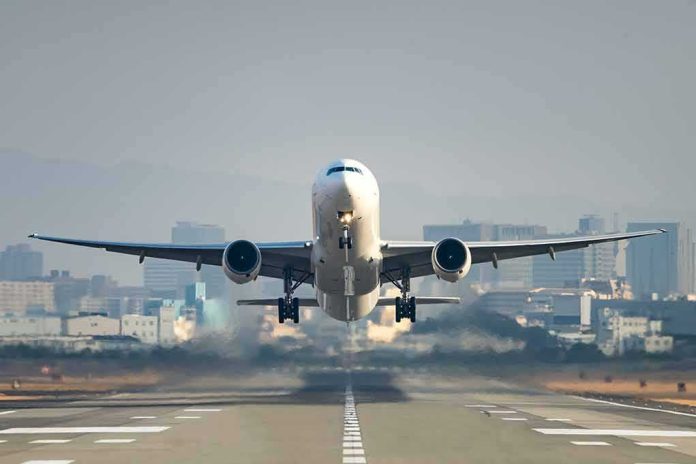
A near-midair collision between a JetBlue airliner and a U.S. Air Force tanker off Venezuela is raising hard questions about Pentagon accountability and civilian safety in the skies.
Story Snapshot
- JetBlue Flight 1112 from Curaçao to New York narrowly avoided a collision with a U.S. Air Force refueling tanker near Venezuelan airspace.
- The JetBlue captain reported the tanker crossed their climb path at the same altitude with no visible transponder, forcing evasive maneuvers.
- U.S. Southern Command, JetBlue, and aviation authorities say they are reviewing the incident amid broader military buildup near Venezuela.
- Conservatives see this as another example of bureaucracy putting ordinary Americans at risk while preaching “safety” and “procedure.”
Near-Collision Over Caribbean Highlights Civilian Risk
On December 12, 2025, JetBlue Flight 1112, an Airbus A320 departing Curaçao for New York’s JFK, climbed north of the island into international airspace when the crew suddenly reported a U.S. Air Force air-to-air refueling tanker cutting directly across their flight path near Venezuelan airspace. The captain radioed that the aircraft were at the same altitude and within just a few miles, forcing the crew to halt their climb and descend to preserve separation and protect more than 100 passengers on board.
Live cockpit–controller audio later shared by major outlets captured the JetBlue captain telling air traffic control they had “almost had a midair collision” and identifying the other aircraft as a United States Air Force refueler. The controller responded there was no traffic displayed, backing the captain’s claim that the tanker was effectively invisible to civilian systems. For everyday travelers who assume the skies are tightly managed, hearing a front-line pilot call the situation “outrageous” drives home how close this came to disaster.
Transponder Silence and Military Buildup Near Venezuela
According to the pilot’s report and subsequent coverage, the Air Force tanker appeared to be operating without an active transponder, meaning it did not show up on civilian radar or traffic displays relied upon by both pilots and controllers. That decision matters because the Caribbean airspace north of Venezuela is busy with U.S.–Caribbean and U.S.–South America routes. When a large, fast military jet moves through that environment “dark,” civilian crews lose a critical safety net that normally helps them avoid exactly the kind of close call JetBlue 1112 experienced.
This incident did not occur in a vacuum. For months, U.S. Southern Command has operated a strong military presence in the southern Caribbean, using tankers and other aircraft to support counter-narcotics and regional security missions near Venezuela. The Federal Aviation Administration had already warned U.S. operators in November 2025 about a “potentially hazardous situation” around Venezuelan airspace due to heightened military activity and regional instability. Commercial flights like this JetBlue route were therefore flying through airspace officially flagged as higher risk, relying on disciplined coordination between military and civilian authorities.
Who Is Responsible for Protecting Civilian Flyers?
Responsibility for investigating the near miss falls primarily on the Curaçao Civil Aviation Authority, which oversees the local Flight Information Region where the encounter occurred. JetBlue says its crew followed procedures, promptly reported the event, and that the airline has notified federal authorities and will cooperate with any investigation. U.S. Southern Command acknowledges it is reviewing the matter and insists its aircrews are highly trained professionals who follow established procedures, repeating that safety remains a top priority even as questions linger about why a tanker was effectively invisible to civilian systems.
For many conservative Americans watching this, the pattern feels familiar: bureaucracies talk about “reviews” and “process,” but the people placed in harm’s way are ordinary citizens who simply bought a ticket home. After years of woke Pentagon priorities, DEI checklists, and social-engineering projects, an incident like this fuels concern that mission focus and basic operational discipline have taken a back seat. When a U.S. military aircraft nearly collides with a U.S. passenger jet in international airspace, the least taxpayers expect is full transparency, accountability, and concrete steps to prevent a repeat.
Conservative Concerns: Safety, Secrecy, and Priorities
From a conservative, America First perspective, this episode cuts in two directions. On one hand, strong U.S. posture against hostile regimes like Venezuela’s socialist dictatorship is essential to national security and regional stability. On the other, that posture must never compromise the safety of U.S. citizens going about their lives. Military operations conducted near busy civilian routes demand maximum coordination, predictable procedures, and active transponders except in the rarest, clearly defined circumstances—not opaque decisions that leave civilian crews guessing about unseen threats in their path.
Many readers who have endured years of government overreach and misplaced priorities—open borders at home, endless foreign entanglements abroad, and exploding debt—see this as another symptom of a system that too often forgets who it serves. They expect the renewed Trump administration to insist that agencies like the Pentagon put core missions and citizen safety ahead of optics or bureaucratic convenience. That means demanding hard answers about this near collision, backing regulators who enforce clear rules, and ensuring that “safety first” is more than a public-relations slogan when American families are in the cabin.