

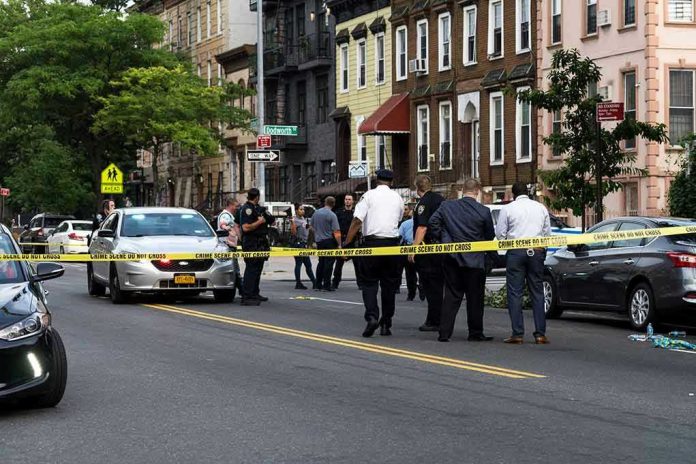
A shocking campus massacre tied to an MIT professor’s killing is exposing how elite universities, lax vetting, and student visas can collide with deadly consequences on American soil.
Story Snapshot
- A Brown University mass shooting suspect is also linked to the killing of an MIT professor.
- Both men once studied in the same physics program in Portugal before coming to the United States.
- The suspect later attended Brown on a student visa, raising serious questions about vetting and oversight.
- The case highlights growing concerns about campus security, immigration controls, and threats to American communities.
Elite campuses rocked by linked shooting and killing
The suspect now at the center of national attention is accused of two shocking acts of violence: a mass shooting at Brown University and the killing of a professor at the Massachusetts Institute of Technology. Authorities say the same man is believed responsible for both attacks, connecting two of America’s most prestigious campuses through a single trail of bloodshed. Law enforcement is still piecing together the full timeline, but the alleged link has understandably rattled students, faculty, and nearby communities.
Investigators report that before either man set foot in the Ivy League or at MIT, the suspect and the slain professor once shared an academic path overseas. Both were part of the same physics program in Portugal, where their careers briefly intersected in a European academic setting. That shared background has intensified questions about motive, possible prior connections, and whether any warning signs existed long before the suspect arrived in the United States on a student visa.
Student visa system and campus security under scrutiny
The suspect later entered Brown University as a physics student on a student visa, a detail that brings America’s immigration and higher‑education systems into sharp focus. Conservative critics have long warned that the student visa pipeline, while sold as a driver of diversity and global talent, can become a security vulnerability if vetting is weak and follow‑up oversight is inconsistent. This case will likely fuel new demands to tighten standards and prioritize the safety of American citizens over institutional prestige.
Campus security practices are also facing renewed examination. Brown University, like many elite schools, promotes an open, urban campus environment that values accessibility and minimal visible policing. After a mass shooting, parents and taxpayers are asking whether that model still makes sense in an era of rising violence and complex threats. Questions about how the suspect obtained any weapons used, whether prior complaints existed, and how quickly campus authorities and local police responded will be central to any forthcoming investigations or lawsuits.
Academic culture, red flags, and missed warnings
The shared history between the suspect and the MIT professor in a Portuguese physics program raises the possibility of long‑running tensions or personal grievances, though officials have not released a confirmed motive. In academic environments, personal rivalries, pressures over research, and mental‑health struggles can simmer beneath the surface for years. When institutions prioritize reputation protection and ideological posturing over honest risk assessment, potential red flags can be downplayed, ignored, or buried in bureaucracy instead of being addressed directly.
Universities today often devote enormous resources to enforcing speech codes, building DEI bureaucracies, and policing pronouns, while basic security, discipline, and common‑sense threat monitoring receive less focus. In that environment, individuals who are troubled, obsessed, or fixated on a mentor, colleague, or rival might slip through the cracks. When such a person also has access to advanced training, international networks, and the ability to move across borders through student visas, the consequences of institutional complacency can be devastating for ordinary Americans who live, work, and study in these communities.
Consequences for policy, parents, and communities
For parents, taxpayers, and neighbors, the linked Brown and MIT cases will likely intensify a broader debate about how far elite institutions and federal agencies should go in balancing openness with security. Many Americans already distrust universities that appear more interested in politics than protection, especially after years of unrest, anti‑police rhetoric, and reluctance to cooperate fully with law enforcement. A deadly incident that involves both a campus mass shooting and the killing of a professor only deepens that unease and strengthens calls for tougher, clearer standards.
Policymakers now face pressure to examine student visa vetting, information‑sharing between foreign and U.S. institutions, and the enforcement of existing immigration and firearms laws. Conservative Americans will watch closely to see whether reforms focus on real security improvements or dissolve into another round of ideological finger‑pointing. With lives lost at Brown and MIT, this case underscores a sobering reality: when institutions treat safety as an afterthought, the cost is often paid by innocent people who simply trusted that America’s campuses were secure places to learn and work.