
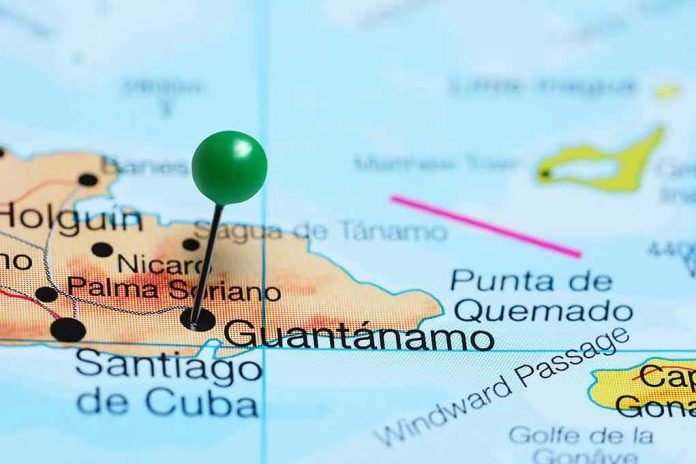
Trump’s Cuba squeeze is turning a failing communist regime 90 miles from Florida into a national-security test with real migration consequences for the United States.
At a Glance
- The Trump administration has tightened pressure on Havana by disrupting Cuba’s access to Venezuelan oil, escalating an already severe economic breakdown.
- A January 2026 White House order declared a national emergency tied to Cuba’s foreign alignments and security threats, setting a formal legal posture for tougher action.
- Cuba’s leadership faces a stark choice: meaningful political concessions—or deeper repression that could drive another surge of mass migration.
- U.S. law still limits how quickly any president can normalize relations, even if Cuba offers partial concessions.
Trump’s Energy Pressure Hits Cuba at Its Weakest Point
President Donald Trump’s second-term Cuba policy is colliding with the island’s worst economic crisis since the 1959 revolution. Reports summarized by Chatham House describe Cuba’s heavy dependence on Venezuelan crude—roughly 27,000 to 35,000 barrels per day—and say U.S. pressure has cut that lifeline while warning would-be replacement suppliers with tariff threats. For ordinary Cubans, the immediate result is brutal: long blackouts, worsening shortages, and a daily scramble for basics.
Multiple accounts agree the collapse is not theoretical. Florida International University’s expert panel describes a state struggling to keep basic services running amid expanding hardship, while NACLA documents how energy shortfalls ripple into transportation, food supply, and medical availability. When the grid fails for extended periods, everything from refrigeration to water pumping becomes precarious. That makes the political situation volatile, because the regime’s social-control model depends on at least minimal stability and predictable distribution.
National Emergency Order Frames Cuba as a Direct U.S. Threat
The White House elevated the issue in January 2026 by issuing an executive order declaring a national emergency related to threats posed by the government of Cuba. The order cites Cuba’s role in hosting and supporting hostile foreign intelligence and deepening ties with U.S. adversaries, which the administration argues creates direct risks to American security. The document also signals that policy can be modified if Cuba aligns with certain security expectations, but it locks in a harder baseline.
Secretary of State Marco Rubio has reinforced that framing publicly, emphasizing that the scale of Cuba’s internal collapse is catastrophic and unfolding just off America’s coastline. The administration’s logic is straightforward: a regime aligned with U.S. adversaries and unable to provide basic stability can produce two hazards at once—security problems and human displacement. That linkage matters domestically because migration spikes, once underway, quickly become enforcement and resource crises for U.S. communities.
Havana’s “Deal” Problem: Concessions vs. Repression
Chatham House reports that President Trump has floated the outlines of a deal to Cuba’s leadership: steps such as releasing political prisoners and moving toward elections in exchange for potential relief. The same reporting notes uncertainty around the negotiation channel, including unconfirmed claims involving Alejandro Castro. What is clear is the dilemma for President Miguel Díaz-Canel: conceding real political openness threatens regime control, while refusing concessions risks even harsher hardship and the kind of unrest the system struggles to manage.
Analysts caution that Cuba is not Venezuela. Chatham House argues that Cuba lacks the resource incentives and cohesive domestic opposition that shaped Venezuela’s trajectory, and FIU experts emphasize how decades of repression have atomized civil society. Those structural realities make quick, clean transitions less likely. Even if Washington turns the screws harder, the island’s leadership may choose repression over reform, and the public may lack the organization to sustain coordinated political change.
U.S. Law and Voters Limit Any “Reset,” Even If Cuba Blinks
One of the least discussed constraints is legal, not tactical. The embargo is embedded in statutes such as the 1992 Cuban Democracy Act and the 1996 Cuban Liberty and Democratic Solidarity Act, which establish conditions tied to political freedoms and multi-party elections. Chatham House notes those laws, along with the political weight of Cuban-American voters, restrict how far any administration can go in offering relief without measurable changes on the island.
That matters for Americans who want clarity instead of slogans. Even if Havana offers partial steps, Washington cannot instantly flip a switch—because the legal framework demands verifiable outcomes, not promises. For conservatives who watched the last decade’s foreign-policy soft-touch rhetoric produce little but stronger adversaries, the constraint cuts both ways: it prevents a rushed “normalization” that ignores political prisoners, while forcing the White House to define what compliance looks like.
The Real-World Stakes: Migration, Security, and a Failing Regime Next Door
Cuba’s breakdown carries an obvious downstream effect: people leave when the lights go out and shelves stay empty. Chatham House and NACLA both describe the island’s crisis as a driver of outward movement, and Chatham House estimates that 2 to 3 million Cubans have fled since 1959. If conditions worsen, a new surge would test U.S. border policy, coastal enforcement, and local services—exactly the kind of pressure voters demanded Washington stop ignoring.
For now, the known facts point to a hardening U.S. posture paired with an unstable Cuban reality. The executive order formalizes the security argument, and the energy squeeze magnifies the regime’s internal stress. The unanswered question is whether Díaz-Canel’s government chooses limited concessions or doubles down on repression. Either way, Americans should expect the administration to treat Cuba less as a nostalgic Cold War relic and more as a live security and migration issue unfolding in real time.
Sources:
Addressing Threats to the United States by the Government of Cuba
Understanding Cuba’s uncertain future with FIU experts
Secretary of State Marco Rubio Remarks to Press