

President Trump’s Michigan stop put two very different economic stories on the same stage: a White House revival pitch and a local fear of higher costs.
Quick Take
- The White House said Trump returned to Michigan to celebrate an auto-industry revival and broader economic progress.
- Trump used the trip to defend tariffs and claim they are helping manufacturing, investment, and affordability.
- Local and regional reports said the same tariffs are raising worries about business costs, prices, and trade disruption.
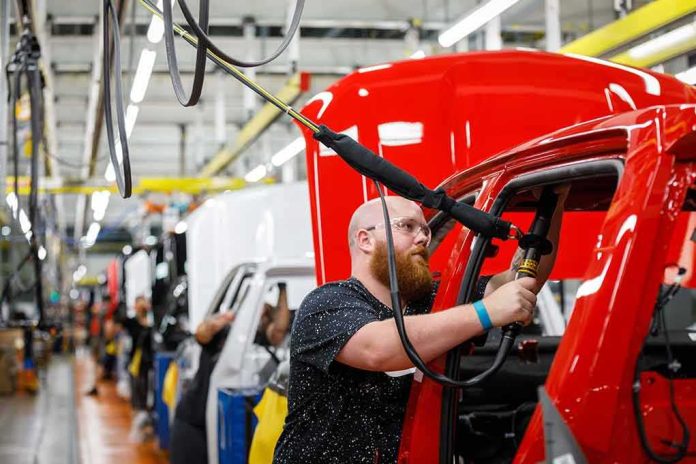
- The trip centered on a Ford F-150 factory visit and a Detroit speech, giving the administration a vivid image of industrial strength.
Trump’s Michigan Message
Trump traveled through Michigan to sell his economic record at a time when voters are still anxious about prices and jobs. In public remarks, he said growth is “exploding,” investment is “booming,” and tariffs are helping the state’s auto sector. The White House backed that message with its own statement saying he returned to “underscore the progress” of economic revival and the “resurgence” of the American auto industry.
The setting mattered as much as the speech. Trump toured a Ford truck plant in Dearborn and spoke at the Detroit Economic Club, both of which gave him a ready-made backdrop for a manufacturing comeback story. The visit also included talk of an affordability plan, showing the campaign-style effort to tie industrial policy to everyday costs. That message aims straight at Michigan’s role as both an auto center and a swing-state battleground.
What The Coverage Says About Costs
Michigan reporting did not treat the trip as proof that tariffs are working. AP said Trump was set to defend his policies in a state where new Canadian tariffs may sting, while MLive said the visit was meant to address a faltering job market and rising costs. India Today also said the administration was trying to counter voter anxiety over jobs, inflation, and the cost of living. Those reports frame the trip as a political defense, not an economic verdict.
Other coverage was even sharper. Bridge Michigan said Trump claimed a “strongest and fastest economic turnaround,” but also noted that he downplayed ongoing inflation and said prices were falling even as many costs kept rising. IPM Newsroom described Michigan as a state “rocked” by steep trade tariffs, and reporting on the new Gordie Howe International Bridge showed the Canadian tariff fight casting a shadow over cross-border trade. That is why many Michigan readers hear “revival” and “disruption” in the same news cycle.
Why Michigan Is So Sensitive
Michigan is unusually exposed because its economy depends on autos, manufacturing, and cross-border commerce. Local reporting said the state is among the hardest hit by the new tariff policy because of its ties to Canada and Mexico and its heavy auto-industry dependence. Reuters also described the White House as trying to refocus attention on the economy while the broader picture stayed mixed, with inflation and gasoline prices still causing concern. That mix makes Michigan a powerful test case for Trump’s trade argument.
🇺🇸🚗 President Donald Trump told General Motors workers in Milford, Michigan, that the state’s automotive industry had been “sold out and betrayed” for decades by politicians and special interests that allowed jobs and factories to move overseas.
Speaking at GM’s historic… pic.twitter.com/XIne1kkU0m
— THE INFORMANT (@TheInformantUSA) July 27, 2026
The evidence in the supplied record supports both sides of the debate in a limited way. The administration has a real factory visit, a real policy message, and a real claim of investment and manufacturing support. But the record also shows no audited Michigan data here proving net gains in output, pay, or household affordability, while multiple reports warn that tariffs can raise costs and strain supply chains. For now, the Michigan story is still a contest between promise and proof.
Sources:
facebook.com, abc7.com, youtube.com, mlive.com, indiatoday.in, whitehouse.gov, wlns.com, apnews.com, fox2detroit.com