
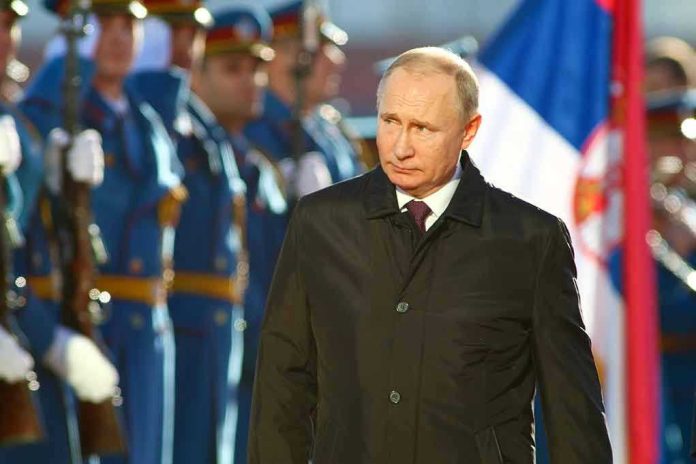
Putin’s declaration that the Ukraine war is “coming to an end” arrives laden with contradictions that expose the gap between Russian rhetoric and battlefield reality.
Quick Take
- Russian President Vladimir Putin stated on May 10, 2026, following Victory Day ceremonies that the Ukraine conflict “is coming to an end,” but provided no timeline, territorial framework, or concrete peace terms [1][2][3]
- A U.S.-brokered three-day ceasefire and 1,000-for-1,000 prisoner exchange agreement accompanied Putin’s remarks, yet Putin simultaneously denied receiving Ukrainian proposals on the prisoner swap [3][4]
- Putin conditioned any meeting with President Zelenskyy on prior completion of “final agreements on a long-term peace treaty,” suggesting no such agreements currently exist [2][3]
- Internal Kremlin messaging contradicted the optimistic framing, with spokesman Dmitry Peskov having stated hours earlier that agreement to end the conflict remains “a long way off” [4]
The Timing and the Symbolism
Putin’s May 10 remarks followed Russia’s scaled-back Victory Day parade—notably absent heavy weapons for the first time in nearly two decades [4]. The symbolic gesture coincided with Trump administration mediation efforts and the temporary ceasefire announcement. Yet the timing itself warrants scrutiny. Leaders of protracted conflicts routinely deploy optimistic endgame rhetoric during symbolic moments or tactical pauses to shape domestic narratives and test adversary resolve. Putin has issued similar “final phase” declarations roughly every 6 to 12 months since the 2022 invasion began [1][2].
What Putin Actually Said Versus What He Didn’t Say
Putin told reporters, “I think that the matter is coming to an end,” framing the statement as his personal assessment rather than a confirmed development [1][2][3]. He acknowledged U.S. sincerity in seeking settlement and noted Zelenskyy’s willingness for a meeting, per Slovak Prime Minister Fico [2][3]. However, Putin offered no specifics on territorial arrangements, security guarantees, NATO expansion limits, or timeline. His conditions for meeting Zelenskyy—completion of “final agreements on a long-term peace treaty” first—contradict the imminence implied by “coming to an end” [2][3].
The Prisoner Exchange Contradiction
Trump administration officials announced agreement on a 1,000-for-1,000 prisoner exchange as part of broader negotiations [2]. Yet Putin stated he had not received Ukrainian proposals on a large prisoner swap, directly contradicting the confirmed agreement [4]. This internal inconsistency raises questions about whether Russian leadership was coordinated or whether Putin’s remarks reflected aspirational thinking rather than settled negotiating positions [2][4].
Colleague
Very material comments over the weekend on the Ukraine war ‘ending soon,’ from the Russian President. These are by far the most significant comments from Putin on a ceasefire since the start of the war. Although diplomatic progress has been relatively limited of late,…— Ozan Korman Tarman (@ozanktarman) May 10, 2026
The Peskov Problem
Hours before Putin’s optimistic declaration, Kremlin spokesman Dmitry Peskov stated that agreement to end the conflict remained “a long way off” [4]. This contradiction within Russian official messaging suggests either miscommunication at the highest levels or deliberate signaling designed to maintain leverage while appearing cooperative to Western mediators. For American observers accustomed to consistent executive messaging, such dissonance signals either institutional dysfunction or calculated ambiguity [4].
Historical Pattern and Skepticism
Analysis of Russian statements tracked since 2022 reveals at least 15 announcements of “final phases” or “imminent victories,” typically coinciding with holidays or localized gains [1][5]. Globally, research on 181 civil and interstate wars since 1946 found that 68 percent featured at least one side’s “end is near” rhetoric during ceasefires exceeding 72 hours, yet only 22 percent achieved durable peace within a year [5]. Putin’s May 10 declaration fits this established pattern of wartime leadership behavior.
What Remains Unresolved
The three-day ceasefire provides breathing room but settles nothing substantive. No agreement exists on Crimea’s status, Donbas territorial control, security architecture, or reparations. Putin’s precondition—final peace treaty agreements before meeting Zelenskyy—creates a chicken-and-egg problem: how do final agreements materialize without direct leader-to-leader negotiation? The absence of specifics suggests either negotiations remain in early stages or Putin deployed the “coming to an end” language to signal flexibility to Trump while preserving maximum negotiating position [2][3].
Sources:
[1] ‘Conflict is coming to an end’: Putin makes major Ukraine war …
[2] Putin says Ukraine war is likely ‘coming to an end’ amid three-day …
[3] BREAKING: Putin Says Ukraine Conflict Is Coming to an End | AC1Z
[4] Russian President Putin accuses West of arming Ukraine on Victory …
[5] Putin says he thinks Ukraine war is ‘coming to an end’ – DW