

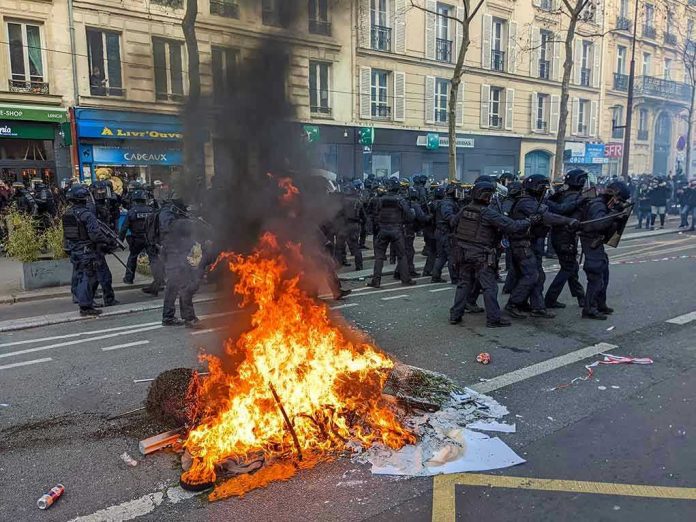
A deadly firebombing that killed a Greek politician’s mother is now testing how far governments will go in the name of “security” when political violence and public distrust are both on the rise.
Story Snapshot
- Greek counterterrorism police arrested three alleged anarchist extremists after coordinated firebomb attacks on ruling party politicians in Thessaloniki.
- The blasts killed 72-year-old Vaya Nestora, injured four others, and marked Greece’s first fatal attack on politicians in more than a decade.
- Crude gas-canister explosives targeted homes tied to the conservative New Democracy party, amplifying fears about rising political violence.
- The case revives long-standing worries, shared by many Americans, about how states use terrorism laws and crackdowns when trust in elites is already low.
Deadly Pre-Dawn Attacks on Ruling Party Figures
Before dawn on July 1, attackers hit three apartment buildings in Thessaloniki tied to members of Greece’s conservative New Democracy party with crude explosive devices made from camping gas canisters and other flammable materials. The blasts were tightly timed, between about 4 a.m. and 4:45 a.m., suggesting planning and coordination, not random street crime. Police say all five injuries came from the third attack, where parked cars and motorcycles caught fire and spread flames into the building’s garage area.
In that third blast, 72-year-old Vaya Nestora, mother of New Democracy parliamentary candidate Afroditi Nestora, suffered severe burns over most of her body and later died of organ failure in the hospital. Her daughter, the candidate, was also burned, and several other residents were treated for smoke inhalation and injuries. Authorities and local media report that the three devices were built in similar ways and detonated within minutes of each other, leading investigators to treat them as a coordinated strike against the ruling party’s local leadership.
Counterterrorism Arrests and Anarchist Extremism Claims
On July 10, Greece’s counterterrorism police announced the arrest of three people in Thessaloniki and on the island of Crete in connection with the July 1 firebombings. The suspects, described in local reporting as anarchist extremists, are accused of carrying out the attacks that killed Nestora and wounded four others. Police say they have linked the arrested individuals to at least the third and deadliest blast, but they have released few details about the evidence, citing the ongoing investigation.
According to the citizens’ protection ministry and wire service reports, this bombing is the first time in more than ten years that a politically motivated attack in Greece has led to a death among those targeted. That fact has put strong pressure on authorities to show they can both stop further attacks and secure convictions that prove the state can still protect its political class and, by extension, ordinary citizens. At the same time, anarchist and far-left groups in Greece have a long record of using small gas-canister devices against government offices, banks, and politicians, usually claiming symbolic resistance rather than mass murder.
Political Anger, Protest Calls, and Fears of Crackdown
Right after the attacks, Prime Minister Kyriakos Mitsotakis called the bombings “cowardly, terrorist and murderous” and vowed to bring the perpetrators to justice. Greece’s New Democracy party urged supporters to take to the streets in protest over the killing of Nestora’s mother, framing the violence as an attack on democracy itself. For many Greeks, the images of burned cars, blackened apartment walls, and a politician’s family targeted at home echo a wider sense that politics has turned dangerous and that normal people are caught in the crossfire.
At the same time, the case taps into old tensions around how governments respond when “terrorism” is invoked. Greece has decades of history with domestic extremist groups, especially anarchists and far-left militants, who claim to fight corrupt elites and foreign influence. Past crackdowns have sometimes swept up activists and protesters who were not tied to bombings, feeding a narrative that the state uses security laws to shut down dissent as much as to stop real terrorists. That pattern looks familiar to many Americans across the political spectrum who see their own government as quick to expand surveillance and policing while slow to fix everyday problems like inflation, migration, and inequality.
Gas-Canister Bombings and Distrust in Elites
Investigators say the Thessaloniki devices used small gas canisters linked to flammable liquid, a signature method long associated with anarchist and far-left attacks in Greece. These devices are cheap, easy to assemble, and usually cause property damage more than mass casualties, which is why they are often described as “low-intensity” tools meant to send a political message. This time, though, the fire spread inside a residential building, killing an elderly woman and injuring several others, turning what might have been intended as symbolic into deadly reality.
For readers in the United States, the story hits familiar nerves. Here, too, many conservatives and liberals believe the system mainly protects the powerful, whether they sit in corporate boardrooms, party leadership, or deep layers of government bureaucracy. Some will see the Greek arrests as proof that states move fastest when politicians are under threat, not when regular families face crime or economic stress. Others will worry that “counterterrorism” labels make it easier to silence radical voices and expand police powers while trust in elites keeps falling.
Sources:
humanevents.com, nbcnews.com, scmp.com, washingtonpost.com, euronews.com, reuters.com, nampa.org, theconversation.com