

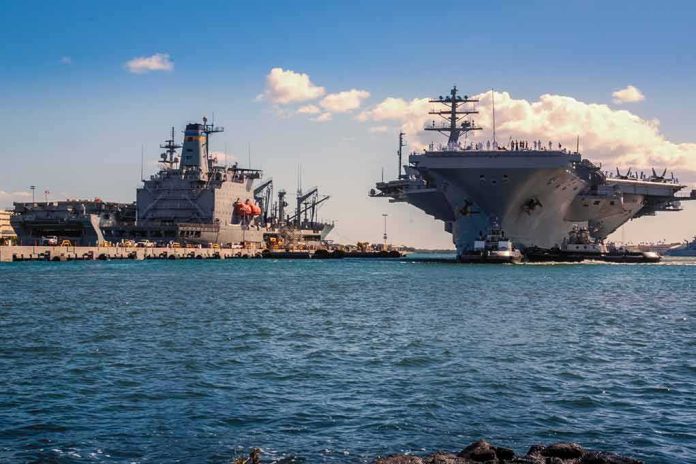
President Trump is keeping a naval blockade on Iran in place even though critics say the move itself counts as an act of war and could spark new fighting.
Story Snapshot
- The U.S. Navy blockade on Iran continues after the midterm elections, alongside a new operation called Task Force Iron Gate targeting land and sea trade routes.
- Critics argue the blockade is itself an act of war under international law and raises the risk of renewed fighting.
- Iran’s foreign minister warned of “hell” if the U.S. resumes attacks, while also offering a deal to end hostilities.
- Secretary of State Marco Rubio says the pressure is working and reduces the need for more strikes.
- History shows sanctions often cause real pain without forcing a country to give in.
Blockade Expands Into New Territory
The Trump administration did not scale back pressure on Iran after Republicans lost ground in the midterms. Instead, U.S. Central Command announced Task Force Iron Gate, a new effort to block Iranian trade routes on land and disrupt shipping across the Caspian Sea. The move adds to an existing naval blockade meant to choke off Iran’s oil exports and government revenue.
Critics say the expansion matters because it shows the campaign is growing, not winding down. The American Conservative argues the blockade itself breaks international law by blocking a nation’s ports without a formal declaration of war, and that continuing it makes a return to full combat more likely. Defense analyst Jennifer Erickson warned Iran has not lost its ability to strike back and may not sit quietly while its economy and people suffer.
Tehran’s Warning Comes With an Offer
Iran’s government has not stayed silent. Foreign Minister Abbas Araghchi posted online that Iran’s two-day proposal to end hostilities still stands, adding that the alternative is war, with Iran’s “battle-hardened Warriors” ready to “rain down hell”. At the same time, Iran reportedly offered to reopen the Strait of Hormuz and halt attacks if the U.S. lifted the blockade and released frozen Iranian money.
That combination is important. Iran is not only threatening retaliation, it is also putting a concrete deal on the table. The blockade sits at the center of that offer, suggesting Tehran views it as the main sticking point in the conflict rather than a side issue.
Administration Says Pressure Is Paying Off
Not everyone sees the blockade as a path to more war. Rubio said sanctions and the naval blockade are inflicting serious economic damage on Iran and reducing the need for more major combat operations. Administration officials reportedly see the squeeze as a way to limit Iran’s ability to fund armed groups and rebuild its military without launching new strikes.
Some supporters go further, arguing the real goal is weakening Iran’s government from the inside by cutting off the money that keeps it running. One online commentator put it plainly: the blockade “is not the objective, but the instrument,” meant to pressure Iran’s rulers rather than punish ordinary citizens directly.
What History Says About Pressure Campaigns
Past examples offer a mixed warning. Presidents facing political setbacks at home have sometimes turned to military action rather than backing down. George W. Bush expanded operations in Iraq after a rough midterm, and Ronald Reagan sent troops into Grenada within a year of his own 1982 losses. That pattern does not prove Trump will escalate, but it shows the temptation exists.
Sanctions research adds another layer. Long-running pressure campaigns, including decades of sanctions on Iran, often cause deep economic pain without forcing the target country to change course. That history suggests the blockade could drag on for a long time without producing either a clear Iranian surrender or an immediate explosion into full war.
Trump Chooses a Third Path on Iran: Economic Strangulation Over War or Deal
* Axios
When Secretary of State Marco Rubio met his G7 counterparts in Paris on Tuesday, he told them President Trump had considered either resuming the war with Iran or striking a deal—but settled on a…
— mahmoud khalil (@sahel2212) November 11, 2026
For now, the standoff leaves Americans watching three moving pieces at once: a blockade some call illegal under international law, an Iranian government mixing threats with a real offer, and an administration betting that economic pain beats another round of bombs. Whether that bet pays off may depend less on legal arguments and more on whether Tehran’s patience runs out first.
Sources:
theamericanconservative.com, iranintl.news, iranintl.com