

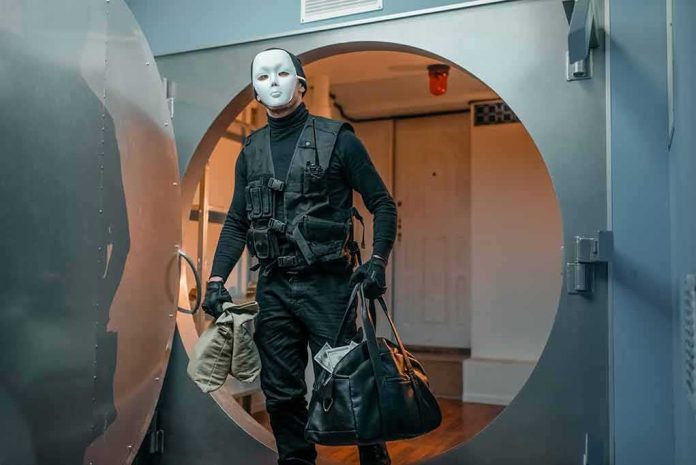
A thief calmly walked out of a San Diego strip club with $25,300 in $1 bills, using a fired manager’s secret code to get into the safe.
Story Snapshot
- Over $25,000 in cash tips, all in one-dollar bills, was stolen from Exposé Gentlemen’s Club in Kearny Mesa.
- Surveillance shows the thief jumping a fence, heading straight to the safe, and using an alarm code tied to a former manager.
- The club’s owner believes it was an inside job, saying staff have unique access codes and the suspect “knew exactly where to go.”
- The case highlights how cash-heavy businesses and workers’ tip money can be exposed when insiders and weak security meet.
How a Strip Club Lost $25,300 in $1 Bills
Early Monday morning in Kearny Mesa, a man jumped a fence at Exposé Gentlemen’s Club and broke into the building. Surveillance video shared with local media shows him moving with purpose, not wandering or searching, but heading straight to the office area. According to owner Dino Palmiotto, the thief then accessed the club’s safe and walked out with exactly $25,300, all in one-dollar bills, representing nights of tip money paid by customers.
Dino Palmiotto told reporters that the thief did not just crack the safe by luck; he used an alarm and safe code linked to a former manager who had been fired about two months earlier. Palmiotto explained that every staff member with safe access has a unique code tied to their own name, so the use of that specific code points to someone with inside knowledge of how the system works. That detail turned a strange cash heist into a troubling question about trust inside the club.
Why the Owner Thinks It Was an Inside Job
On camera, Palmiotto said the suspect “knew exactly where to go” and “was communicating with someone,” suggesting the man was being guided in real time by someone who understood the building and security. So far, no public evidence has surfaced to challenge his core claims about the code, the fired manager, or the amount taken. Police have not named suspects, and there are no public records yet showing whether investigators have confirmed the code use through system logs or digital forensics.
This kind of suspicion is common in cash-heavy businesses, especially adult clubs, where many owners blame “inside jobs” when large sums go missing. In one Rhode Island strip club case, a $22,000 theft in one-dollar bills was later proven to be an inside job when an employee was arrested. That history makes Palmiotto’s theory feel plausible, but it still remains a claim, not a proven fact. Without public counter-evidence, the owner’s narrative fills the vacuum and shapes how people view the crime.
Tip Money, Wage Theft, and Broken Trust
Behind the odd detail of $25,300 in one-dollar bills sits a serious issue for workers: those singles are how many dancers and servers earn a living. Denver’s labor office has found strip clubs owing nearly $14 million in pay and tip theft to entertainers and staff, showing how often workers’ money gets mishandled or taken. In that report, officials stress that tips belong to workers the moment they are given and cannot legally be claimed by owners or managers.
Thief steals over $25K in one dollar bills at Kearny Mesa strip club https://t.co/8eMRJoQUur
— CBS 8 San Diego (@CBS8) July 1, 2026
When a safe full of singles disappears, it is not just “the club’s money” that vanishes; it can be the earnings of people already fighting unpaid wages, high rent, and rising prices. Many Americans, conservative and liberal, feel the system punishes workers while protecting owners and middlemen. Stories like this feed that anger, because once again people with inside access seem able to walk off with cash, while those who worked late nights to earn it are left waiting for justice that may never come.
Inside Jobs, Weak Security, and a Bigger Pattern
Experts on employee theft warn that insiders often use access codes, security blind spots, and trust to steal money or data from employers. They note that theft is not only physical grabbing of cash; it can also be quiet skimming, fake hours, or sharing access codes for a cut of the payout. They advise businesses to split key duties, rotate staff, audit cash and inventory, and keep access logs so that one person cannot easily control and drain a safe without detection.
For many readers, this San Diego case fits a larger fear: regular people must follow rules and pay taxes, yet those with insider knowledge walk between the raindrops. Whether it is worker pay withheld, tips “lost,” or cash stolen with a code that should have been disabled, the pattern feels the same. Systems that are supposed to protect hard-earned money are often weak, slow, or badly managed, and when they fail, ordinary workers and customers pay the price.
What This Says About Trust in Institutions
Across the political spectrum, people see stories like this as proof that important systems are not built to protect them. Conservatives angry about crime and weak enforcement see another example of authorities playing catch-up while insiders exploit loopholes. Liberals worried about inequality and worker rights see tip money and wages at risk in an industry already tied to wage theft cases. Both sides are left wondering why basic safeguards for cash and worker pay are not stronger and more transparent.
This one theft at a strip club in Kearny Mesa will not decide national policy. But it does shine a light on a deeper worry in 2026 America: those with codes, connections, and inside knowledge can still beat the system, while those who simply do the work must hope someone, somewhere, finally makes security and fairness more than just talk.
Sources:
nypost.com, yahoo.com, exposesd.com, instagram.com, exoticdancer.com, youtube.com, scribd.com, pubmed.ncbi.nlm.nih.gov