
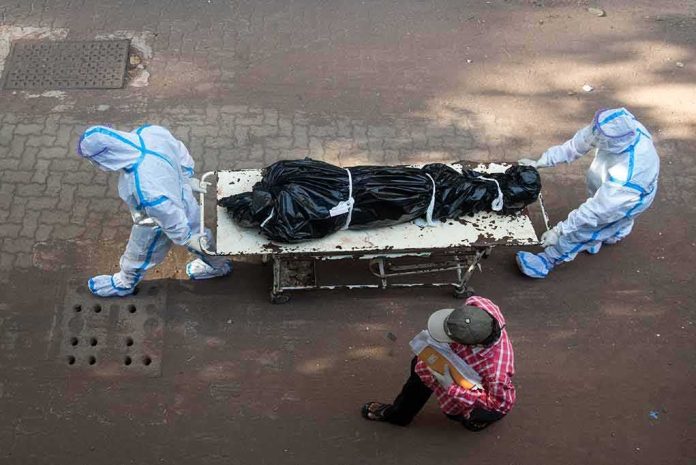
La Guaira’s port has turned into a grim waiting room, where families search for the dead after the earthquakes.
Story Snapshot
- Hundreds of bodies and coffins have been brought to a temporary morgue in La Guaira.
- Families are trying to identify relatives as the death toll keeps rising.
- Authorities say many victims are hard to recognize because of the condition of the bodies.
- The missing-person count remains huge, and public reporting has been inconsistent.
A Port Filled With the Dead
A temporary mega morgue has been set up in La Guaira, and it is now handling hundreds of bodies and coffins brought in after the June 24 earthquakes. The port scene shows how fast a natural disaster can outgrow local systems. It also shows why disaster victim identification becomes so hard when remains are damaged, time is short, and families are desperate for answers.
Reports say many relatives had to pull loved ones from the rubble themselves before coming to the morgue to look for them. That detail points to a larger breakdown in the chain that usually moves from rescue to recovery to identification. When families become the first search teams, the state is already behind. The result is not only grief, but a heavy burden on ordinary people who are forced to track the dead themselves.
The Identification Problem Keeps Growing
Authorities have said the condition of many bodies is making identification harder, and some remains are being cremated for public health reasons. That creates a painful tradeoff. The faster the dead must be handled, the less time families and forensic workers may have to confirm who is who. In mass-casualty events, experts usually rely on fingerprints, dental records, DNA, and other records to match the dead with missing persons.
The scale of the disaster is part of the problem. Official figures in the research package put the death toll at more than 1,450, while other reporting cited even higher totals as the count kept changing. The missing-person estimates are also large, including a figure of more than 43,000 in one source and about 50,000 in another. When numbers move that much, families face more uncertainty, and public trust takes another hit.
Why Families Are Losing Confidence
The report from La Guaira fits a broader pattern seen after major disasters: identification slows when records are incomplete, services break down, and communication collapses. The research says basic services and connectivity have been badly damaged in the area, which makes it harder for relatives to report missing people or receive updates. In that setting, even a well-run morgue can become a bottleneck if families cannot reach the system that is supposed to help them.
Earthquake victims fill Venezuela port morgue
Hundreds of coffins lined La Guaira port as families identified victims.
The temporary morgue was set up after the deadly earthquakes struck five days earlier.
NASA says more than 58,000 buildings were damaged or destroyed. pic.twitter.com/EF29ww8SQs
— HG Policy (@hgpolicy) July 1, 2026
The deeper issue is not only the number of dead, but whether the process can stay transparent enough for people to trust it. The research package notes that Venezuelan authorities have not given a single clear missing-person total, while outside groups have used different counts. That kind of gap fuels suspicion on all sides. In a country already shaped by weak institutions, families are left asking whether the official process can keep pace with the human loss.
What Comes Next for Recovery
The clearest path forward is also the most basic one: better records, wider forensic support, and a shared list of the missing. Disaster victim identification works best when teams collect body data, family reports, and DNA or dental records in one system. The research also points to the value of outside forensic help and unified databases. For grieving relatives, that is not a policy debate. It is the difference between a name and a number.
Sources:
youtube.com, facebook.com, time.com, interpol.int, icrc.org