

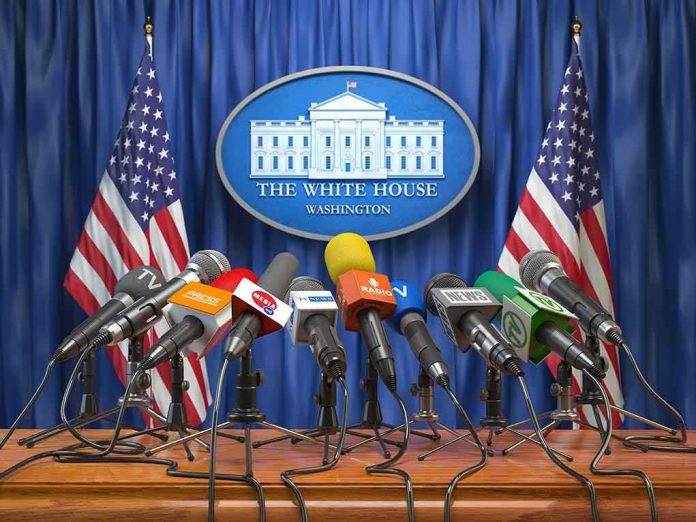
President Trump said he is banning CNN, MS NOW, and Politico from the White House “effective immediately,” citing “fake news.”
Story Snapshot
- Trump announced an immediate ban on three outlets from White House access.
- He tied the ban to “fake news” and “purposely negative stories.”
- Press-freedom groups and outlets called the move unconstitutional.
- Reports say it is unclear how and whether the ban was enforced.
What Trump Announced And Why It Matters
On September 18, President Trump said CNN, MS NOW, and Politico were banned from the White House “effective immediately.” He posted the message and warned other outlets could follow. He linked the action to what he calls “fake news.” He also claimed Politico had an “illegal” eight million dollar federal subscription, which he called corruption, without producing the contract. The announcement raised alarms because it targets named outlets for their coverage.
Trump also spoke from the Oval Office and said reporters should not be allowed to write “fake stories.” He described “fake” as “purposely negative stories,” not just false ones. That definition blurs opinion and error and makes viewpoint the issue. That is why legal experts and press advocates quickly flagged First Amendment risks. The claim of an illegal Politico payment remains an accusation in reports, not a proven record.
How Press And Legal Groups Responded
CNN said the ban would be an “illegal assault” on a free press and vowed to keep reporting on the White House. Politico said it would fairly report and “vigorously defend” its First Amendment rights. The White House Correspondents’ Association said the move amounts to a “ban on the free press.” These groups stressed that press rights do not depend on whether a president likes the questions or the stories.
Reuters reported that free speech experts said the ban conflicts with the First Amendment and would likely face lawsuits. The Freedom of the Press Foundation called banning outlets over coverage a “blatant” violation. These reactions point to a fast legal track if the administration follows through. That track would test whether the government used neutral rules or punished speech based on viewpoint.
What Is Known About Enforcement So Far
Several outlets confirmed the announcement and its “effective immediately” language. But some reports said there was no clear sign of follow-through at the time. Other reports noted that journalists from named outlets were still on site after the post. Without a visible directive, badge revocations, or entry logs, the scope and timing of enforcement remain unclear to the public. That gap invites confusion and fuels both sides’ narratives.
#BREAKING : TRUMP BANS CNN FROM WHITE HOUSE “THROWN OUT”
President Donald Trump has announced an immediate ban on CNN, MS NOW and Politico from the White House, accusing the outlets of spreading what he called “fake news.”
Trump also warned that more media organizations could… pic.twitter.com/zoHZh8wXue— Aware International (@aware_official1) September 19, 2026
This dispute fits a larger pattern. Trump has long battled press access and framed it as a response to “fake news.” Courts have recently weighed similar fights. In the Associated Press case, judges reaffirmed that when the government opens spaces to some reporters, it cannot exclude others because of viewpoint. That line is central here. If the White House applies content-based bans, courts may again step in to block them.
Why Both Sides See A Bigger Stakes Fight
Conservatives see legacy media as biased, and many cheer a hard line. Liberals see a White House trying to silence critics. But many Americans across parties share a deeper worry. They believe elites in government and media play by their own rules while trust keeps falling. A ban that appears tied to negative coverage, without detailed proof of falsehoods, feeds that worry. Clear rules, transparent records, and due process would help restore trust.
What To Watch Next
Watch for a formal written policy, credential changes, and any role by the United States Secret Service. Look for lawsuits testing whether the ban is viewpoint-based. Watch for proof behind the Politico funding claim, such as contracts or audits. Track whether other outlets get named and whether pool access changes. Concrete documents, not posts, will show if this is a symbolic warning or a binding policy with legal risks for the White House.
Sources:
cbsnews.com, english.news.cn, ntd.com, axios.com, ca.finance.yahoo.com, kesq.com, indiatoday.in, uk.news.yahoo.com, globalnation.inquirer.net, abcnews4.com