

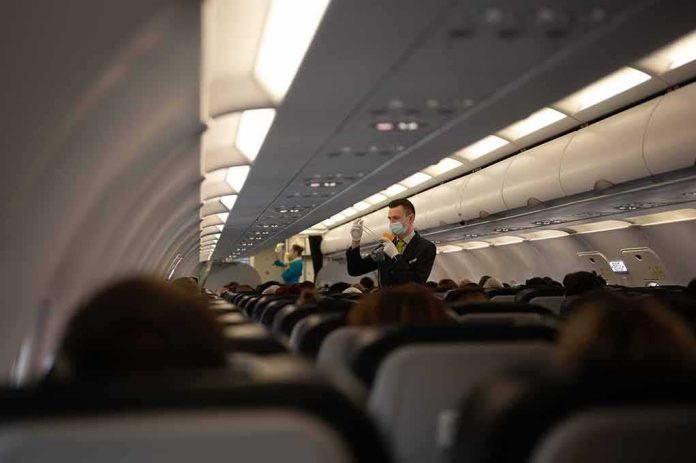
A stabbed captain opened the cockpit, a rushing crowd stopped a crash, and 174 people lived.
Story Snapshot
- Israel’s prime minister says a pilot stabbed his captain and tried to crash a Flydubai jet.
- Passengers and crew forced the cockpit door and restrained the attacker, enabling a safe landing.
- The plane diverted to Tabuk, Saudi Arabia, after a sharp descent and emergency alerts.
- Netanyahu praised the wounded captain’s actions and saluted passenger bravery.
What Happened Aboard Flydubai FZ1073
Israeli Prime Minister Benjamin Netanyahu said a pilot stabbed the captain on a Dubai-to-Tel Aviv flight and “apparently tried to crash the plane.” Passengers and crew entered the cockpit and overpowered the attacker as the aircraft descended, then the jet diverted and landed safely in Tabuk, Saudi Arabia. Israeli officials said off-duty Flydubai pilots aboard helped take control. Netanyahu praised the injured captain and called the incident a “highly severe security event”.
Air traffic data and airport statements align on the diversion to Tabuk and the safe landing. Reporters detailed a rapid drop of thousands of feet and scenes of panic in the cabin as the struggle played out up front. The airline said all passengers survived. Saudi authorities detained the suspect for questioning, according to accounts citing Israeli officials. Netanyahu highlighted the captain’s effort to open the cockpit door despite bleeding, which allowed others to intervene.
Why The Crew’s Response Worked
Airlines lock cockpit doors during flight to protect the controls, a policy strengthened after the September 11, 2001, attacks. That same barrier can trap trouble inside if violence starts in the flight deck. In this case, the wounded captain reportedly managed to activate the cockpit door release. That single act let trained crew, passengers, and two off-duty pilots enter, restrain the attacker, and stabilize the aircraft for a diversion and safe landing.
Emergency signaling can confuse the public, but it helps controllers clear airspace fast. Pilots use a general distress transponder code to declare an emergency. They can also set a special hijacking code if they cannot speak freely. Both codes are designed to alert air traffic control and speed help, which is likely part of why the jet got priority routing into Tabuk. Speed and clarity save lives when seconds count.
How This Fits A Pattern Of Rare, High-Stakes Incidents
The event fits a small but serious category: crew-related interference. These are rare cases where an insider sparks an emergency that looks like hijacking. In 2023, an off-duty pilot in a cockpit jump seat on a U.S. regional flight allegedly tried to shut down engines; the crew restrained him and landed safely. The logic here is similar: quick action by trained professionals, aided by passengers, breaks the chain of disaster before it becomes irreversible.
TERROR IN THE SKY: Flydubai pilot attempts terror hijacking of flight to Tel Aviv, foiled by Israeli passengers
Israeli official says “major disaster avoided” after pilot stabbed his co-pilot, attempted to hijack aircraft with over 100 Israeli passengers
Plane makes emergency… pic.twitter.com/27ZhiEdl9P
— Brian Harrod (@GetTheDailyDirt) October 1, 2026
Published reports say the plane plunged before it stabilized and diverted, with both pilots injured but passengers safe. That outcome tracks with standard training. Crews drill for loss-of-control, medical crises, smoke, and cockpit breaches. Checklists, team coordination, and clear command often decide the day. Two off-duty pilots on board added depth. Their presence meant fresh hands to fly, run checklists, and manage radios while others restrained the attacker.
What Leaders Are Signaling About Next Steps
Netanyahu framed the episode as a grave security attack and publicly commended those who fought to save the jet, including the wounded captain. That framing points to tougher screening and cockpit access reviews along routes facing higher threat pressure. It also matches conservative common sense: reward courage, harden weak points, and back professionals who act under fire. Saudi authorities holding the suspect suggests a cross-border investigation with a close look at motive and method.
What Matters For Flyers Right Now
Commercial aviation remains safe because it builds layers: locked doors, trained crews, checklists, alerts, and clear authority in the cockpit. No single layer is perfect. Together they stop bad days from becoming last days. This flight shows those layers still work under the worst stress. The lesson for policy makers is simple: keep standards high, keep cockpits secure, and never sideline the calm discipline that saved a planeload of families over Saudi skies.
Sources:
facebook.com, theguardian.com, bbc.com, arabnews.com, washingtonexaminer.com, thehill.com