

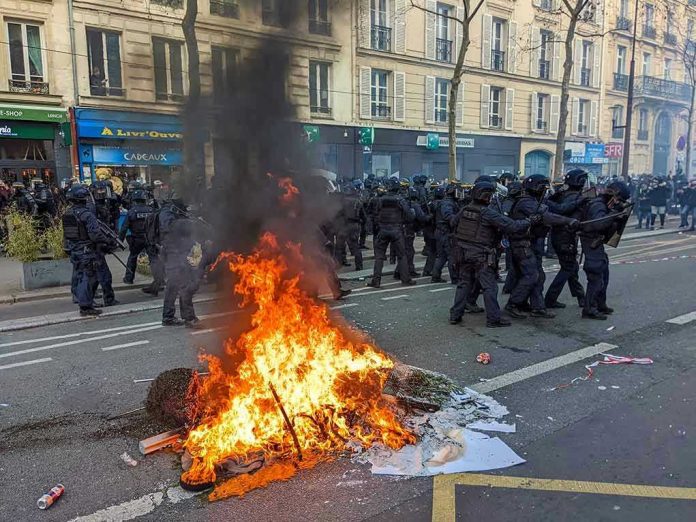
Scott Jennings’s on-air claim that France’s riots are a “civilizational” revolt tied to migration ran straight into reporters’ evidence that police have not linked immigrants to the violence.
Story Snapshot
- Scott Jennings tied France’s unrest to migration and Western decline on CNN.
- Associated Press said officials have not linked immigrants to the rioting.
- Reports trace the protests to student anger over schools and living costs.
- Arrest data showed most detainees were minors, complicating migrant claims.
What Jennings Said And Why It Exploded On Air
Scott Jennings said on CNN that France, and Europe more broadly, are suffering a migrant crisis and framed the riots as an attempt to tear down Western civilization. He pointed to scenes of arson, looting, and public buildings under attack, and he noted protesters waving Palestinian colors. His comments sparked pushback because they drew a straight line from unrest to migration and ideology without official confirmation tying recent migrants to the violence.
Jennings’s framing lands in a charged American debate. President Trump and Republican figures often cite European unrest as a warning for the United States. Viewers on the right hear a case for border control and tougher assimilation. Viewers on the left hear scapegoating of immigrants and a dodge from root causes like inequality. The clash reflects a wider worry many Americans share: leaders argue on television while basic problems fester and spread.
What Official Records And Reporters Actually Establish
Associated Press reported that French authorities have not linked immigrants to the rioting and do not publish race or ethnicity data, which limits proof about who took part. The report also states that officials have not identified a specific group as responsible. That does not disprove cultural tensions, but it does mean the migrant-led claim lacks documented backing at this stage.
Media accounts describe a different spark. Students protested crowded classrooms, teacher shortages, and decaying school buildings. Those marches widened into anger over high living costs, low wages, and a bleak outlook for young people. Coverage from The National, Newsweek, and Vox links the origins to schools and then to a broader social squeeze. That chain of events challenges the idea that the first cause was migration.
Arrests, Ages, And The Limits Of A Simple Narrative
Arrest figures reported in coverage show that most detainees were minors, often high school students. Those numbers do not list nationality, immigration status, or ideology. They do undercut a neat story about recent adult migrants driving the riots. When most arrests are of teenagers, the picture looks more like local youth anger that later drew in other actors, lawful and unlawful, across many towns.
Another outlet noted that many protests began in working-class suburbs with large communities of immigrant origin. That pattern is real, but it does not prove that recent migration caused the violence. France’s privacy rules and its ban on ethnic statistics make it hard to test claims either way. Without individual-level data on citizenship and status, the public is left with maps, videos, and political claims that do not settle causation.
Competing Claims, Shared Fears, And What Would Settle It
Conservative politicians in France, like Marion Maréchal, argue that “mass, unassimilated immigration” fuels youth violence. That view offers a mechanism: poor integration and weak allegiance to national norms. It speaks to voters who see elites fail on borders and order. But it is still a claim, not evidentiary proof of who lit fires or smashed windows in each incident. That gap invites more heat than light.
Preventing French-Style Unrest in the US: Questions for Officials
Oct 20, 2026Why these questions?
France’s 2026 unrest—sparked by school blockades and cost-of-living protests—escalated via insufficient control and excessive force. These questions assess U.S. plans for…— Navajo (@Navajo47) October 20, 2026
Student voices and union demands point to another driver: schools in decay, wages that do not cover basics, and a future that seems closed. Organizers say policies favor the well-off and squeeze everyone else. That story resonates with Americans who work hard yet fall behind while politicians bicker. It also fits a long French pattern where a local spark meets old grievances and spreads fast through stressed suburbs.
Why This Matters For America
United States leaders on both sides can learn here. First, do not rush to causal claims the data cannot support. Second, do not ignore visible breakdowns in schools, housing, and youth prospects. When officials hide key data or refuse to release anonymized arrest profiles, they feed mistrust. Releasing age, charge, and status summaries would help the public judge claims on all sides without doxxing anyone.
Americans see a pattern: elites argue on cable, while city services decay and prices climb. France is a warning about what happens when leaders miss obvious stress points. Secure borders and strong assimilation matter. So do safe schools, fair wages, and basic order on the streets. Countries that duck either side of that equation end up with fires, finger-pointing, and no plan to rebuild.
Sources:
townhall.com, apnews.com, newsday.com, foxnews.com, novinite.com