
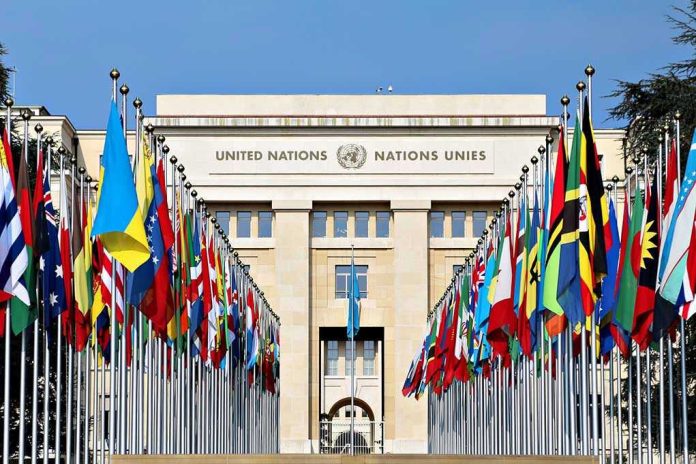
A United Nations debate on Cuba’s embargo was abruptly suspended after U.S. and Cuban envoys clashed face-to-face on the General Assembly floor, underscoring how global rules buckle when power politics turns personal.
Story Snapshot
- The General Assembly session paused after a shouting match between U.S. and Cuban representatives.
- Most countries again backed a resolution urging an end to the U.S. embargo on Cuba in recent votes.
- Washington defended sanctions as necessary for security and accountability, citing Cuba’s ties to adversaries.
- Cuba and United Nations officials tied tighter sanctions to energy and health crises affecting civilians.
A Floor Fight Stops the United Nations Cold
United Nations proceedings halted when a dispute between the United States envoy and Cuba’s foreign minister spilled from speeches into a direct confrontation on the General Assembly floor. The presiding officer suspended the session to restore order, an uncommon step that signaled how tense the embargo debate has become. The clash came during the annual discussion on Cuba, where emotions were already high after sharp accusations and counter-accusations from both delegations earlier in the day.
United States remarks framed the embargo as a tool to promote accountability and protect national security. The U.S. envoy accused Cuba of corruption and repression and linked Havana to adversaries and destabilizing actions in the region, including support for Venezuela’s leadership. That argument echoed Washington’s long-standing view that sanctions are leverage against hostile networks. The American message was clear: the costs of easing pressure would fall on security interests and on people suffering under an unfree system.
A World Body That Keeps Saying “End It”
The diplomatic brawl unfolded against a steady voting record in the General Assembly. In recent years, member states have adopted, by large margins, a resolution that urges an end to the United States embargo on Cuba. The 2025 vote recorded 165 in favor, 7 against, and 12 abstaining, continuing a three-decade pattern of near-uniform calls to lift the restrictions. These votes are symbolic but influential, reflecting broad frustration with unilateral sanctions.
While the resolution does not bind the United States, it sets a moral and political backdrop every year. Many governments argue the embargo hurts ordinary Cubans and isolates the United States diplomatically. The repeated votes also show how routine the pressure has become, even as the exact margins shift with global politics. That history gave yesterday’s floor clash more weight, since both sides knew the likely outcome of the debate.
Human Costs Cited by Cuba and United Nations Officials
Cuba’s foreign minister told delegates that sanctions block fuel shipments through threats and intimidation of tankers, squeezing power generation and transport. He said the measures “suffocate and kill silently,” claiming they target the population as much as the state. United Nations coverage tied tighter measures to an energy crisis and warned of risks to health and food. Officials reported more than 100,000 postponed surgeries this year as shortages hit hospitals.
Academic and policy analysis has also found that United States sanctions raise the costs and risks of doing business with Cuba. The research links these rules to reduced access to finance, technology, and foreign investment, which can drag down growth and delay repairs to basic infrastructure. These findings do not prove that sanctions alone cause every shortage. But they reinforce claims that broad financial limits can ripple across daily life and strain public services.
Why This Matters Beyond Havana and Washington
The United Nations floor confrontation showed how fragile norms look when core narratives collide. The United States message centered on security, sovereignty, and leverage. Cuba and many other countries highlighted civilian pain and a rules-based order that frowns on unilateral coercive measures. Both claims speak to a deeper worry shared by many Americans: powerful actors fight for advantage while people bear the cost and institutions struggle to mediate fairly.
Rodríguez called Waltz a liar, while the US envoy demanded that he step back. The heated exchange forced the UN meeting to be temporarily suspended.
❓ Is this normal diplomacy, or are tensions between nations reaching a new level? pic.twitter.com/nIBopyVJ2X
— The Insight Affairs (@TInsightAffairs) October 28, 2026
For readers at home, the stakes are familiar. Energy markets, migration pressures, and regional stability do not stop at borders. Policy that aims to punish a regime can also raise costs for families and businesses, from higher shipping rates to new supply gaps. Supporters of sanctions argue that easing pressure rewards repression. Critics argue that decades of embargo have not delivered change but have hurt ordinary people. The United Nations keeps voting. Washington keeps holding the line.
What to Watch Next
Watch whether the General Assembly’s latest vote changes any country positions in practice. Look for any new United States carve-outs for medical or energy relief, which could ease pressure on hospitals while keeping security tools intact. Track whether Cuba expands transparency or reforms that could attract lawful investment. And note whether future United Nations sessions can avoid disorder. When debate turns into a floor fight, diplomacy loses the public it needs most.
Sources:
youtube.com, news.un.org, digitallibrary.un.org, unny.mission.gov.au, cambridge.org