

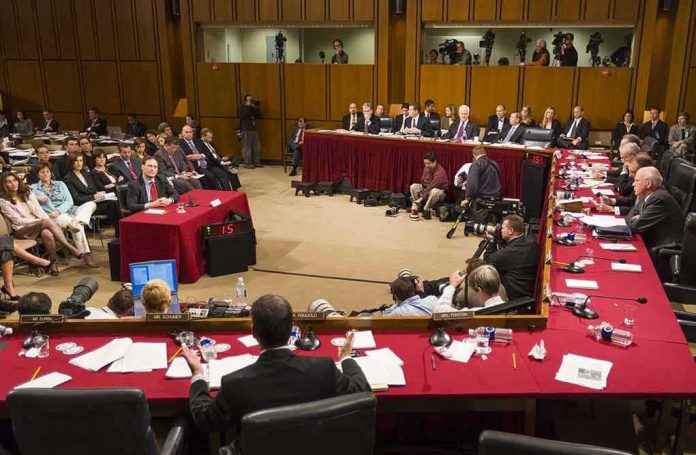
In a tense Senate hearing, former Attorney General John Ashcroft told Senator Adam Schiff that the president sits atop all federal law enforcement, sharpening a long‑running fight over whether the Justice Department has become a weapon for the powerful instead of a shield for ordinary Americans.
Story Snapshot
- Schiff says no Democratic president ever ordered an attorney general to prosecute political enemies and warns that today’s Justice Department is crossing that line.
- Ashcroft answers that the president is the head of the executive branch charged with enforcing federal law, but says law must be applied without regard to politics.
- The clash exposes how both parties fear “weaponized” prosecutions, yet hard proof of direct presidential orders against specific opponents remains rare.
- Decades of scandals from Watergate to the Trump era show a pattern of blurred lines between politics and justice, feeding today’s deep distrust of Washington.
Schiff’s Warning About Presidents Ordering Prosecutions
Senator Adam Schiff opened his questioning by drawing a sharp line between past practice and what he says is happening now. He claimed that in all modern Democratic administrations, no president called the attorney general and said, “You need to prosecute him, and you need to prosecute her,” meaning direct orders to go after political opponents. He argued that after the abuses of President Richard Nixon, reforms were put in place to make the Justice Department more independent from the White House, so that prosecutions would be driven by law, not by political revenge.
Schiff went further and said the current Justice Department has “pursued prosecutions against political opponents even without any basis to do so,” claiming there are cases where grand juries unanimously refused to indict. He did not name specific cases or defendants, which makes the claim hard to verify for the public or even for Ashcroft, who replied that he did not know of such an example. To show how dangerous selective enforcement can be, Schiff argued that if laws are enforced differently based on who is out of favor politically, “you can go find something wrong with anybody you want,” turning justice into a tool of fear instead of fairness.
Ashcroft’s Defense of Presidential Authority and Neutral Law Enforcement
John Ashcroft responded by grounding his answer in the Constitution’s basic structure. He said the President of the United States “is the executive branch,” and that this office carries the duty to enforce the laws of the nation. In his view, the president not only can but should push for strong law enforcement, especially against those who commit violent acts against Americans, whom he described as “enemies.” That framing reflects Ashcroft’s long record after the September 11 attacks, when as attorney general he championed aggressive counterterrorism tools such as the USA PATRIOT Act and expanded information‑sharing between prosecutors and intelligence agencies.
At the same time, Ashcroft tried to draw his own boundary line. He said that law enforcement must be applied “without regard to the political preferences of the people who are perpetrators or accused individuals,” stressing that justice must not depend on whether someone is pro‑Trump, anti‑Trump, Democrat, or Republican. He did not directly embrace the idea of prosecuting “political enemies” as such, but he also did not fully answer Schiff’s hypotheticals, such as charging a person over harmless photos of seashells or punishing senators for videos about refusing illegal orders. That left some viewers feeling that the legal limits on presidential direction were still fuzzy, even in the eyes of a former attorney general.
Long History of Fears About “Weaponized” Justice
The Schiff‑Ashcroft exchange fits into a much larger American story. For decades, citizens on both the right and left have worried that federal prosecutions can be used to win political battles rather than simply enforce the law. Scholars who study “political trials” note that cases against powerful figures often unfold in the middle of fierce struggles for power, which makes it hard to separate legal decisions from political motives. A long line of scandals—from Watergate in the 1970s to newer controversies involving surveillance, torture memos, and counterterrorism powers—shows how executive branch lawyers have sometimes stretched or reshaped legal rules to serve presidential agendas.
Those patterns matter today because many Americans no longer trust the system to police itself. Academic work on federal public‑corruption prosecutions points out that the Justice Department gained huge centralized power over time, while checks on that power often lagged behind. Civil liberties groups have accused Ashcroft himself of working to limit court review of some Justice Department actions and of disregarding unfavorable court orders, which raises questions about how firmly independence norms were honored even in past administrations. When citizens see elites on both sides bending rules with few consequences, it reinforces the belief that there is one justice system for the powerful, and another for everyone else.
What This Clash Signals in Today’s Distrustful Politics
For conservative readers, Schiff’s comments may sound like another attempt to block tough enforcement and to protect the establishment from accountability. For liberal readers, Ashcroft’s broad claims about presidential power may ring alarm bells about a White House that can lean on prosecutors whenever opponents become inconvenient. The important shared concern is this: if presidents can quietly steer prosecutions against enemies, or if prosecutors silently tilt cases based on politics, then regular Americans cannot trust federal law to be neutral, and the dream of fair chances under the law fades.
Legal scholars have begun to offer ideas to reduce that fear, such as using bipartisan panels of former prosecutors to review high‑level political cases before charges are filed. These ideas admit a hard truth that both sides now feel: the federal government has not earned the benefit of the doubt. The Schiff‑Ashcroft showdown did not settle where the legal line sits between firm enforcement and political payback. But it did show how close many believe we are to crossing a point where the Justice Department no longer protects the people from the powerful, but instead protects the powerful from the people.
Sources:
justice.gov, pbs.org, aclu.org, govinfo.gov, en.wikipedia.org, hls.harvard.edu, phys.uri.edu, opened.cuny.edu