

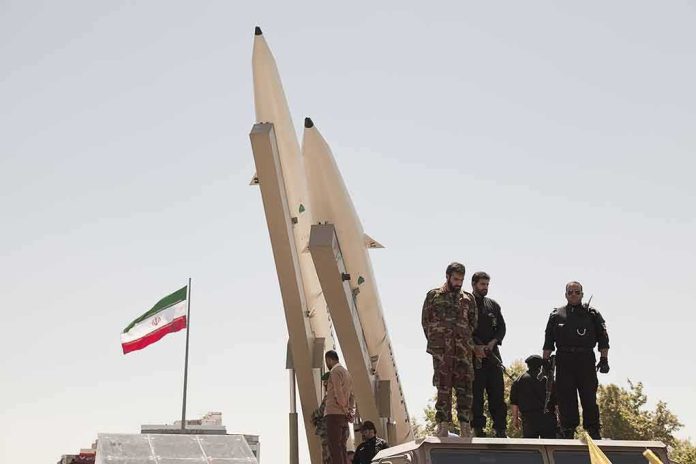
When Iranian commanders say they will “change the geography of the war,” they are not speaking metaphorically; they are signaling a doctrine that treats any new U.S. strike on Iran as permission to widen the battlefield to every regional node that enables American power—bases, logistics hubs, sea lanes, and, crucially, the territories of host states that allow them.
The Short Version
- Iran’s formal military chain—Khatam al-Anbiya Joint Headquarters and the IRGC—has warned that renewed U.S. attacks would trigger sustained, “without limitation” strikes on all U.S. bases and interests across the region, including in host countries.
- Those threats are consistent with Iran’s proven toolkit: missiles, drones, and proxy-enabled pressure beyond Iran’s borders, calibrated to raise costs and fracture coalitions.
- U.S. officials typically frame their own strikes as limited, discrete degradations of Iranian capability; Iran’s message aims to make such “limited” actions strategically expensive by widening the battlespace in response.
- The strategic contest is about deterrence credibility—who convinces the other side, and the region’s host states, that escalation will hurt more than it helps.
What Tehran Is Actually Threatening
The backbone of Iran’s warning is institutional, not rumor mill. Public statements carried by state-aligned outlets attribute the message to the Khatam al-Anbiya Joint Headquarters and the Islamic Revolutionary Guard Corps (IRGC), pledging “continuous, effective, and painful” retaliation “without any limitation or reservation” if Iran is struck again. Those same statements explicitly expand the target set to “all U.S. bases and interests in the region” and caution regional governments that host American forces that they, too, will be treated as part of the battlespace in any renewed fight. The phrasing is sweeping and unqualified; it is also deliberate—Tehran is tying its retaliation not just to Washington, but to every airport apron, radar site, fuel depot, and command node that makes American force projection possible nearby.
This is not empty theater in form, even if the ultimate choice to act is contingent. Iran has repeatedly used cross-border strikes—ballistic missiles, cruise missiles, and one-way attack drones—to answer U.S. or Israeli actions, often claiming to hit U.S. installations in Jordan, Syria, and the Gulf states. The IRGC’s own messaging portrays such attacks as a standing option: a known play they can run again, not an improvisation. Whether every claimed effect is as advertised is another question, but the method and intent are consistent.
Mechanism: How Iran Widens the Battlespace
Iran’s escalation ladder is designed to be regional from the outset. It blends three instruments. First, direct fires: short- and medium-range ballistic missiles, land-attack cruise missiles, and long-range drones launched from Iranian territory. Second, deniable or semi-deniable attacks by partner militias and proxies—rockets from Iraq, drones from Yemen, harassment at sea—that complicate attribution while spreading risk across geography. Third, coercive signaling toward host governments, aimed at forcing them to curtail U.S. access or at least raise the political cost of continued basing. The threats aimed at “countries that host the aggressor American military” are not rhetorical garnish; they are the second front in Iran’s deterrent, seeking to peel partners off the U.S. coalition by making them feel targeted for America’s choices.
Iran’s military apparatus under Khatam al-Anbiya sits atop this mix as the joint command that can synchronize IRGC aerospace forces with conventional army assets and regional proxy channels. When that headquarters speaks of “no limitation,” it is describing authority to use multiple launch vectors and target classes, not a suicide pact. Tehran’s intent is to impose depth: to force Washington to worry about Bahrain while it is focused on the Strait of Hormuz, and to make Doha, Abu Dhabi, and Amman pressure the United States for restraint because their infrastructure could be next. The aim is political as much as kinetic.
Why Iran Says It Now—and Why It Often Works
Deterrence runs on expectation management. U.S. officials typically describe their own strikes as discrete actions to “degrade” Iranian capability or to preempt immediate threats—particularly to shipping. That language signals control and bounded aims. Iran’s answer is to threaten to make any such bounded action unbounded in consequence, not by symmetry (hitting Iran for hitting Iran) but by expansion (hitting the region for hitting Iran). In other words, Tehran wants every U.S. planner and Gulf cabinet to believe that a “limited” raid on Iranian soil buys a multi-country problem the next day. The potency of that message is precisely why it is issued through the formal chain—so it carries the weight of doctrine, not punditry.
This is also historically grounded. In past rounds of escalation, Iran or its partners have fired on U.S.-linked targets across multiple countries after American strikes on Iranian territory or assets. Even when damage claims are contested, the pattern of regional response—and the scramble it induces in host nations—advances Iran’s political objective: to raise the cost of U.S. access and fracture consensus among allies over how far to back Washington when the fight jumps borders.
The Evidence and Its Limits
Much of the most vivid wording—“change the geography of the war,” “without limitation”—comes via Iranian state-aligned media or downstream summaries, which reliably convey intent but do not offer independent transcripts in every case. That creates translation and context risk around exact phrasing. Likewise, Iranian claims of having “destroyed” specific U.S. bases often outpace independent verification; U.S. accounts, when public, tend to downplay effect. Those caveats matter for assessing battle damage, not for understanding doctrine. The strategic signal—regional retaliation against U.S. forces and host states in the event of renewed strikes—is consistent across outlets and over time, and it is aligned with the capabilities Iran has already demonstrated.
On the U.S. side, official descriptions of “limited, precise” strikes to degrade Iranian capacity, particularly maritime threats, present a contrasting narrative: controlled escalation with narrow aims. That framing does not negate Iran’s warning; it is the exact behavior Iran seeks to deter by threatening to make “limited” feel very costly in Riyadh, Manama, Doha, Abu Dhabi, and Amman. The two narratives pass each other like trains on parallel tracks—both can be true in intent while colliding in practice once missiles fly.
Implications for Host States and Coalition Management
For regional governments, the center of gravity is risk tolerance. Hosting U.S. forces brings security guarantees and deterrent benefits, but it also paints a bullseye when Tehran is in a retaliatory posture. Iran’s message is tailored to exploit that anxiety: if you provide runways, ISR feeds, or logistics to support U.S. strikes on Iran, you are inside the battlespace by choice. That pressure works best when paired with demonstrations of reach—drone debris on a runway, a damaged fuel farm, or even the credible threat against a desalination plant. These are not abstract risks. They are the lived calculus of governments that control critical infrastructure and dense urban populations within range of Iranian systems.
For Washington, the task is coalition hardening. That means real air and missile defense integration, distributed basing to reduce single-point vulnerabilities, rapid repair capabilities, and political groundwork so partners do not panic at the first hit. It also means owning the contradiction in public messaging: you can pursue limited military aims, but you must plan for an adversary determined to expand the geography in response. Pretending otherwise invites surprise.
Iran hands US a new set of conditions for restarting negotiations, warning of retaliation without limitations if any new attacks occur. Reza Hatami has more pic.twitter.com/0QWitWUAIW
— TRT World Now (@TRTWorldNow) September 21, 2026
What to Watch When the Next Crisis Looms
Three indicators test the credibility of Tehran’s threat in real time. First, posture: visible movement of Iranian aerospace assets, proxy alerting, and command statements from Khatam al-Anbiya rather than media surrogates. Second, target language: explicit inclusion of host-state infrastructure in the warning corpus—airbases, ports, and logistics corridors by name rather than in generalities. Third, coalition behavior: quiet U.S. advisories to partners, dispersal of aircraft and munitions, and elevated air defense readiness at bases beyond the immediate flashpoint. When those three align, Iran is not merely talking about expanding the war’s geography; it is preparing to do it.
Sources:
cbsnews.com, en.mehrnews.com, kurdistan24.net, tribuneindia.com, tabnak.ir, newindianexpress.com, timesnownews.com, hindustantimes.com, reuters.com, nytimes.com, npr.org