

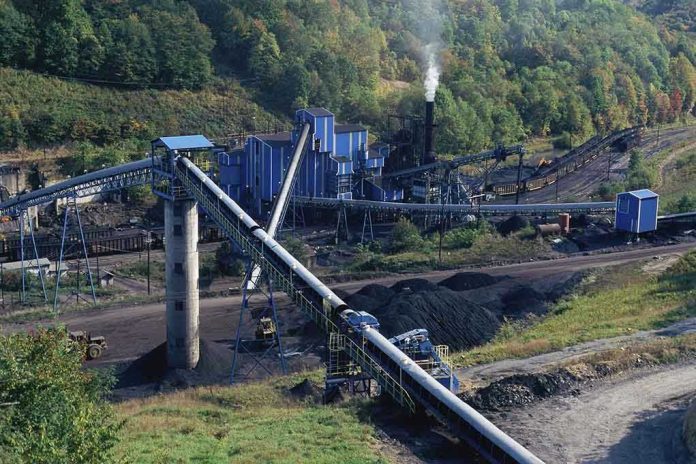
A $700 million Trump coal initiative is about to test whether American energy security and blue-collar jobs can beat back years of green mandates and grid fragility.
Story Snapshot
- President Trump is preparing roughly $700 million in federal support to modernize, restart, and expand coal power and export capacity.
- Critics call it a bailout for a “declining” industry, but the White House frames it as essential for national defense and grid reliability.
- Key tools include long-term military power contracts and redirected energy funds to keep plants online and revive shuttered units.
- The fight reflects a deeper clash between dependable baseload energy and the costly green agenda that has strained family budgets.
Trump’s $700 Million Bet On Coal And National Security
President Donald Trump is moving ahead with a plan to channel nearly $700 million in federal support into the coal sector, combining new funding with previously announced modernization initiatives to keep plants running and build new capacity for power and exports.[2] White House fact sheets describe coal as central to national defense and “baseload” reliability, and an executive order directs the Department of War to lock in long-term power purchase agreements for military and critical defense facilities. This uses existing emergency and defense authorities to turn coal into a strategic asset rather than a political punching bag.
The Department of Energy has already laid the groundwork by redirecting more than half a billion dollars in previously approved infrastructure and carbon-capture funds toward rebuilding and restarting coal-fired plants.[2] A recent notice of funding described $525 million available to build, restart, overhaul, or retrofit coal plants, signaling that the administration prefers to strengthen existing assets quickly instead of waiting years for new projects to clear permitting hurdles.[2] For many communities that watched coal units slated for closure by 2030, these moves mark a sharp reversal from the “war on coal” under prior administrations and give local workers renewed hopes for steady paychecks.
Modernizing Plants To Keep American Lights On
The Trump energy team argues that modernizing coal plants is the fastest, most cost-effective way to stabilize the electric grid as power demand surges from data centers, manufacturing reshoring, and electric vehicles.[1][2] The Department of Energy has rolled out multiple funding rounds to retrofit aging units, improve efficiency, and extend their useful life, including a $175 million package for six plants that serve rural and remote communities.[1] Officials say these projects are designed to keep dependable baseload power online, strengthen grid reliability, and hold down electricity prices for households and small businesses that have been squeezed by years of rising energy bills.[1]
Additional federal dollars have been targeted to modernization research and pilot projects that upgrade remaining coal plants with better wastewater systems, fuel flexibility, and co-firing capabilities so they can operate more efficiently and affordably.[3] One announcement committed up to $100 million for such projects, following a broader $625 million push to “expand and reinvigorate” the coal industry through recommissioning closed units and modernizing existing ones.[3] Energy Secretary Chris Wright has also highlighted coal’s designation as a critical mineral tied to national and economic security, and Interior Department actions to open federal land for new coal mining are meant to ensure a stable domestic fuel supply for these upgraded plants.[2]
Critics Warn Of Costs As Supporters Emphasize Jobs And Reliability
Environmental groups and some policy analysts are attacking the $700 million package as a subsidy for what they describe as a declining and polluting industry, insisting that redirected funds from earlier clean energy programs amount to “burning money” on coal rather than accelerating wind and solar.[2][3] An independent analysis of prior Trump-era orders to keep coal plants running estimated that such policies could cost consumers billions of dollars over time, framing the intervention as a hidden tax on ratepayers to benefit plant owners. These critics argue that long-term trends in fuel prices and technology will continue to favor natural gas and renewables even if coal gets a temporary reprieve.
President Donald Trump will announce a plan today to send $425 million in government funding to 13 existing coal power plants in the US, as well as $185 million to build two more, @jendlouhyhc reports.
— Josh Wingrove (@josh_wingrove) June 4, 2026
Supporters respond that those same green policies have already delivered the hidden tax in the form of higher electricity prices, fragile grids, rolling blackouts, and job losses in coal country, while hostile foreign suppliers profit from America’s self-imposed restrictions.[2] The White House says designating coal as critical, lifting barriers to mining on federal lands, and backing plants with defense-related power contracts will increase energy supply, lower electricity costs, stabilize the grid, and create high-paying jobs in mining, power generation, and transport. For many conservatives, the $700 million plan is less a “bailout” and more a course correction—shifting Washington away from ideological experiments and toward reliable, American-made energy that underpins both national security and family budgets.
Sources:
[1] Web – Trump plans $700 million investment in new coal plants and terminal
[2] YouTube – Trump directs Pentagon to buy electricity from coal plants
[3] Web – Trump admin redirects carbon capture funds to prop up old coal plants