

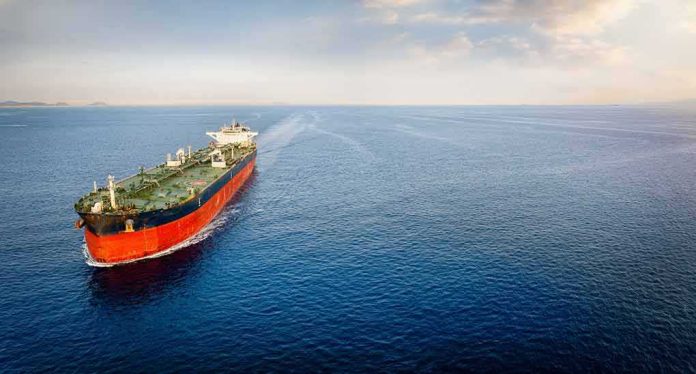
The Houthis have turned a regional shipping threat into a wider test of U.S. military strain, and tankers have already reacted by changing course near Yemen.
Quick Take
- Houthi officials announced a maritime embargo against Saudi Arabia and warned shipowners away from Saudi ports.
- Ship-tracking reports showed at least seven oil tankers altered course after the warning.
- The Red Sea remains a fragile route, with past Houthi attacks already driving ships away from the area.
- Defense analysts say no military strike can guarantee the Houthis will stop targeting ships.
Tankers Reacted Within Hours of the Houthi Warning
Houthi military spokesman Yahya Saree said the group was imposing a maritime embargo on Saudi Arabia and warned vessels not to call at Saudi ports. BBC reporting said at least seven oil tankers altered their routes near Yemen after the announcement. That immediate movement matters because it shows how quickly a threat can change behavior, even before any new attack is launched or any blockade is fully enforced.
The warning fits a pattern that has defined the Red Sea crisis since late 2023. Houthi threats have often come in stages, and shipowners have tended to reroute first, then wait for proof of enforcement later. Research on the campaign says the group has carried out more than one hundred attacks since November 2023, while other assessments put the wider total at more than 300 targeted ships. That history gives the latest embargo more weight than a one-off political statement.
Why the Red Sea Remains So Sensitive
The Red Sea and Bab el-Mandeb corridor sit on a major trade lane for energy and cargo moving between Asia, the Middle East, and Europe. Shipping has already been hit hard by the Houthi campaign, with vessels diverted away from the region and traffic falling sharply at several points since the attacks began. A recent warning therefore lands in a market that is already cautious, expensive, and built around avoiding risk rather than testing it.
That is why even a limited threat can ripple into fuel costs, insurance, and delivery schedules. Some analysts say the Houthis have repeatedly scaled threats up or down for political effect, but the practical result has still been rerouting and delay. The World Bank has also said reduced disruption is possible only if attacks stay limited, which shows how fragile the situation remains when armed groups use shipping lanes as leverage. For businesses, the cost begins before the first ship is hit.
What It Means for the United States
The latest warning also adds pressure on a U.S. military that is already stretched across several missions. Defense Priorities says there is no credible military option that guarantees an end to Houthi attacks on ships, and that strikes alone are unlikely to change the group’s strategy. That assessment points to a hard problem for Washington: protecting commerce, deterring attacks, and avoiding escalation all at once, while the adversary needs only a few successful threats to keep markets nervous.
The broader lesson is not limited to one country or one route. The Houthis have shown that a non-state group with drones, missiles, and a coastal position can affect global shipping far beyond Yemen. That reality helps explain why both sides of the American political divide keep circling back to a shared complaint: the federal government often reacts after damage is done, while ordinary families and businesses absorb the costs in higher prices, slower trade, and more uncertainty.
The Houthi maritime embargo against Saudi Arabia and their subsequent missile and drone attacks on the tankers ENCELIA and LAYLA in the Red Sea represent a critical expansion of the U.S.–Iran conflict.
— Leinona Aoki (@LeinonaA69) July 22, 2026
For now, the key question is not whether the Houthis can make noise in the Red Sea. It is whether they can keep doing it long enough to shape shipping patterns, energy flows, and U.S. response options at the same time. The latest embargo threat suggests they can still force caution across a vital waterway, even without closing it outright or stopping every ship in sight.
Sources:
19fortyfive.com, en.wikipedia.org, news.az, lloydslist.com, documents1.worldbank.org, reuters.com, atlasinstitute.org, bbc.com, washingtoninstitute.org, aei.org