

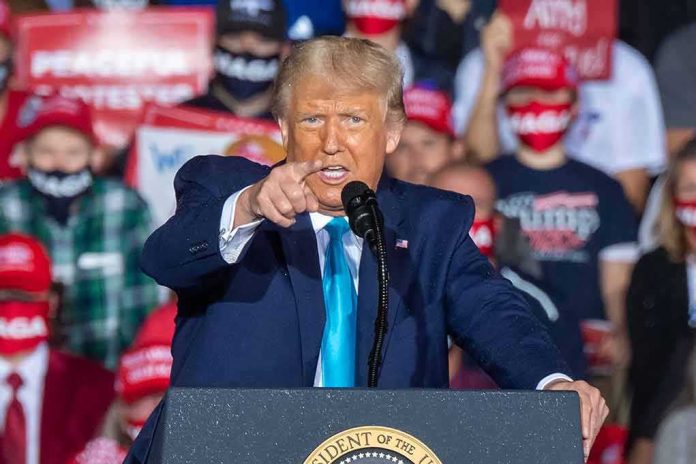
President Trump used a Labor Day message to label Democrats “Radical Left Lunatics, Communists, and Dumocrats,” and warned they are making “one last shot at ruining America.”
Story Highlights
- Trump’s Labor Day post attacked Democrats and warned of a last-ditch attempt to “ruin America.”
- The message fits Trump’s long-running pattern of sharp, hard-edged rhetoric against political opponents.
- Scholars have tracked a rise in violent or hostile vocabulary in Trump’s language over time.
- The clash reflects wider frustration that Washington elites ignore working Americans across party lines.
Labor Day Message Targets Democrats With Stark Labels
On Monday, September 7, President Trump posted a Labor Day message that praised workers while slamming Democrats. The post called his opponents “Radical Left Lunatics, Communists, and Dumocrats” and warned they would “do anything possible to destroy our Country.” He added that his rivals had spent 10 years fighting him and were taking “one last shot at ruining America,” while he vowed to defeat them. Reporting reproduced the statement as it appeared online.
Trump’s message also pointed ahead to political fights that remain central to his agenda. He has tied support for workers to tighter immigration enforcement, energy production, and trade measures in other recent remarks. That framing pitches the White House as pro-worker and paints Democrats as aligned with elites. The Labor Day post kept that combative tone, linking national renewal to beating political enemies he says are harming ordinary families. The language echoed past campaign-style lines.
Rhetoric Aligns With Documented Communication Pattern
Researchers who study presidential language say Trump’s style stands apart from other modern leaders. One broad analysis found his discourse more distinctive and more divisive than recent nominees from either party. The study measured how often speeches drive wedges, especially when naming rivals. Trump’s Monday post matches that trend by using sharp labels for opponents instead of policy terms. This consistent pattern helps explain why his words trigger strong reactions across the spectrum.
Academic work also tracks a steady rise in violent or hostile vocabulary in Trump’s public remarks over the years. A National Bureau of Economic Research paper reports that his use of such words has increased since 2015 and now tops other democratic politicians in the sample. While the Labor Day post did not call for violence, its talk of enemies and ruin fits the broader arc of combative language that scholars describe in his communications.
Why The Message Resonates With Frustrated Voters
Millions of Americans on the right and left feel that Washington serves insiders first. Many think career politicians protect their own power while costs rise, wages lag, and rules grow. Trump’s message taps that anger by blaming “elites” on the other side for national decline. Democrats reject that charge, but the appeal lands with people who see factories closed, bills up, and leaders arguing instead of fixing problems. The post reinforces a clear us-versus-them frame.
Trump in Labor Day Message Says GOP Will Win Big in Midtermshttps://t.co/mSBhIMq9Oq
— YoungDuck (@lduck623) September 7, 2026
For conservatives, the message echoes complaints about border chaos, energy prices, crime, and culture fights. For liberals, it reads as another attack on democratic norms, social programs, and immigrants. Both groups, though, share doubt that Washington can manage costs, deliver good jobs, or police corruption. That shared doubt explains why harsh political words keep spreading. The shrill tone signals to core voters that a leader is fighting, even as policy fixes move slowly in Congress and agencies.
What To Watch Next For Policy And Politics
The White House will likely keep linking worker support to border enforcement, American energy, and tariffs. If the focus holds, expect more orders and bills that aim to favor domestic producers and cut migration. Democrats will press back with arguments about health care, wages, unions, and equality. The contest will test whether sharp language boosts turnout without turning off the middle. Voters who want serious fixes will look for results beyond posts and speeches.
How Today’s Tone Shapes Tomorrow’s Debate
Political research suggests that norm-breaking language can harden attitudes and reduce support for inclusive values among a leader’s backers. That shift can make compromise harder and raise the stakes of each vote. Trump’s Labor Day message fits that high-stakes frame by casting the moment as a last-ditch fight. The approach may rally loyalists, but it also risks deeper division. The country will feel the cost if leaders cannot turn heat into practical gains for workers.
Sources:
democrats.senate.gov, newsweek.com, cnn.com