

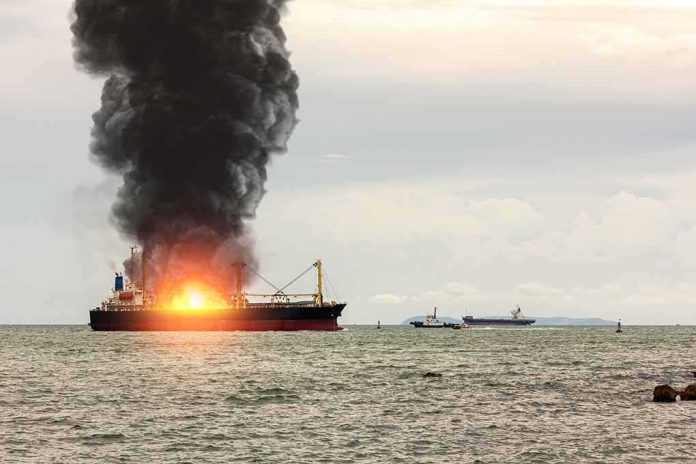
A Russian warship burned, capsized, and sank at Benghazi’s naval base after an explosion that Libyan authorities say likely came from a drone strike, pulling Libya into a dangerous shadow war far from Ukraine’s front lines.
Story Snapshot
- Libya’s eastern government says a suspected drone attack triggered the explosion aboard the Russian corvette Merkury.
- Satellite images show the ship catastrophically damaged, capsized, and partly sunk in Benghazi port.
- Associated Press cites Libyan military officials who point to suspected Ukrainian sea drones; no one has claimed responsibility.
- Early accounts conflicted, adding uncertainty about the weapon type and attacker.
What Libyan and media reports confirm so far
Libya’s eastern-based administration reported that an explosion occurred aboard a Russian ship docked at Benghazi and said a drone attack is suspected based on early findings. Reporting by Reuters-linked coverage identified the vessel as the Russian corvette Merkury and described widespread fire, capsizing, and partial sinking near the pier. Independent satellite images match that outcome, showing debris and smoke at the site. The physical damage is not in dispute. What caused it, and who did it, remain open questions in public view.
Associated Press, citing two Libyan military officials, reported that suspected Ukrainian sea drones struck the Merkury and set off a major fire. Those officials did not go on record by name in that account, and neither Russia nor Ukraine had publicly confirmed the claim at the time of those reports. No group has claimed responsibility. The eastern government said it launched an investigation with Russian partners to identify the source and those responsible, but findings beyond the initial suspicion were not released.
Why early narratives diverged
Local services in Benghazi first described an explosion at an ammunition depot, not on a Russian ship, which fueled confusion in the opening hours. Some accounts mentioned attempts to intercept an unidentified aerial object before the blast, while other reports described sea drones as the likely weapons. One thread even referenced a sea drone targeting a commercial ship off Benghazi, a claim that clashes with the warship account. These conflicting details are common in fast-moving crises, especially where rival authorities and armed groups shape the flow of information.
Satellite imagery helps fix the timeline and the result, but it cannot by itself prove whether an aerial drone, a maritime drone, or an internal blast caused the initial explosion. That is why investigators look for fragments, residue, and damage patterns to determine the weapon type. No such forensic evidence has been publicly presented in the cited reporting. Until that record appears, the most supportable public line is this: the Russian corvette Merkury was destroyed after an explosion and fire in Benghazi, and Libyan officials suspect a drone attack.
Why this matters beyond Libya
A suspected strike 1,000 miles from Ukraine suggests the war’s tools now reach far beyond the main battlefield. Drones—air or sea—are cheap, mobile, and hard to trace. They empower weaker actors to hit targets in ports where defenses are uneven. That spreads risk to shipping lanes, energy routes, and coastal cities. For families and businesses already facing high prices and unstable supply chains, more attacks on ports could mean cost spikes and longer delays. That hurts ordinary people, not elites.
Libya’s divided politics raise the stakes. Competing authorities in the east and west, plus strong militias, create gaps in security and messaging. Those gaps let foreign players move pieces on the board. People on both the right and left in the United States worry that unaccountable networks profit from chaos while regular citizens pay the bill. This incident feeds that fear: once again, murky actors may be shaping events, and the public gets few clear answers.
How to separate fact from spin
Look for four things in the days ahead. First, an official wreck survey that maps blast damage and burn patterns. That can show if the explosion came from outside or inside the hull. Second, photographs or lab reports on recovered fragments. Serial numbers and residue can indicate a weapon type or supplier. Third, port logs and radar data, which can place drones or small craft near the pier. Fourth, on-record statements from named officials, not only anonymous ones. These are the building blocks of solid attribution.
Russia lost a warship on Sunday, about 1,800 km from Ukraine, tied up in someone else's port.
The corvette Merkury was struck by sea drones inside the Benghazi naval base in eastern Libya, where she'd docked for fuel and supplies. Libyan officials told AP several drones were… pic.twitter.com/plNkwj37tH
— OSINT Middle East Observer (@osintmeobserver) November 23, 2026
Until then, treat grand claims with care. The established facts are clear and serious: a Russian warship was destroyed in Benghazi after an explosion and fire, and Libyan officials suspect a drone attack. The rest—who launched it, from where, and with what—needs public evidence. Citizens in every camp share a basic demand here: tell the truth, show the proof, and secure the ports that keep food, fuel, and goods moving. Anything less feeds distrust—and leaves the door open for the next strike.
Sources:
youtube.com, afp.com, english.nv.ua, militarnyi.com, unn.ua