
Ecuador’s president says there is no U.S. base, but flight logs, tents, and a new hangar tell a harder story to ignore.
Story Snapshot
- President Daniel Noboa rejects claims of a U.S. base at Taura, calling the missions temporary.
- Agence France-Presse counted about 20 U.S. military flights and saw new structures at the air base.
- A status-of-forces deal gives U.S. troops legal standing without authorizing foreign bases, on paper.
- A fired air chief warned the activity risked crossing Ecuador’s constitutional line on foreign basing.
What Ecuador’s President Says Is Happening
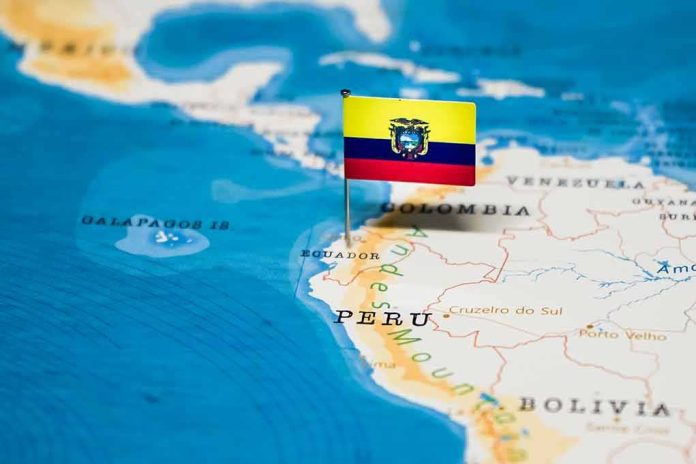
President Daniel Noboa said U.S. personnel at Taura Air Base are there for short, specific missions. He said they are not running an American base in Ecuador. He described tasks like drone intelligence flights and framed the presence as temporary under a bilateral security deal. His message tracks with Ecuador’s constitution, which bans foreign bases. He insists Ecuador keeps control, and that the United States operates only with permission and within set limits.
Reporting also points to a status-of-forces agreement that covers the legal standing of U.S. personnel. Such deals define things like entry, uniforms, and jurisdiction. They do not, by themselves, create a foreign base. Analysts say Ecuador’s agreement took effect in 2024 and left the base ban in place. The government argues this framework allows joint security work while keeping sovereignty at Taura in Ecuadorian hands.
What Investigations Saw On The Ground And In The Air
Agence France-Presse reviewed flight data and found about 20 U.S. military flights in and out of Taura from June to mid-October 2026. The flights included large cargo planes and tiltrotor aircraft. Satellite images showed tents and a retractable hangar, roughly 40 by 20 meters. Documents referenced U.S. troops at the base. These findings do not prove a permanent base. But they show sustained activity that is hard to square with one-off visits.
The evidence raises practical questions. Who authorized each flight? Who controlled the ramp and the hangar? How long could the structures stay? Without answers, the line between “temporary access” and “de facto basing” blurs. In public debate, visible gear and repeated flights often outweigh legal labels. That is why this case has stirred local concern and global attention. The activity pattern, not just the paperwork, now drives the narrative.
Internal Warnings And A Sudden Command Change
On September 8, Air Force Commander Mauricio Salazar wrote a letter that asked for the legal rules to govern U.S. use of Taura. He warned that hosting troops, supporting U.S. Air Force missions, and receiving continuing flights might breach Ecuador’s constitution. He stressed that Ecuador must keep operational and administrative control. Two days later, he was removed from his post and reassigned, without a full public explanation.
President Noboa says there is no American base in Ecuador. Yet AFP documented US aircraft, dozens of tents, infrastructure work and about 20 US military flights at the Taura Air Base near Guayaquil, and the president himself admits US personnel are there. He did not address the… https://t.co/3gPRSf5DZ2
— Luis M. Carrasco Brenes (@lc_brenes1981) November 16, 2026
Officials have said cooperation continues but shared few details. That silence leaves a gap that flight logs and imagery now fill. For many citizens, this pattern feels familiar: leaders promise limits, activity grows, and accountability lags. People on the right and left see the same risk. Powerful actors can stretch legal language while facts on the ground harden. Transparency would help. Clear, published orders and access rules could show who is in charge, for how long, and to what end.
Why This Matters Beyond Ecuador
This fight echoes a wider global trend. Governments try to balance security help with sovereignty. They often claim a host-nation facility is only being used, not turned into a foreign base. Critics look at control, duration, and infrastructure. They ask if “temporary” becomes routine. Ecuador has lived this before with the U.S. site at Manta. That history makes today’s debate sharper, and the stakes higher for public trust and the rule of law.
What Would Build Public Trust Now
Three steps could calm the storm. First, publish the full status-of-forces agreement and any rules that apply to Taura. Second, release flight authorizations and command logs that show Ecuador’s control in real time. Third, document the hangar and tents as temporary, with removal terms and dates. These actions would not end all doubt. But they would replace rumor with records and show respect for the constitution that voters expect their leaders to defend.
Sources:
france24.com, adamisacson.com, afp.com, globalsecurity.org