

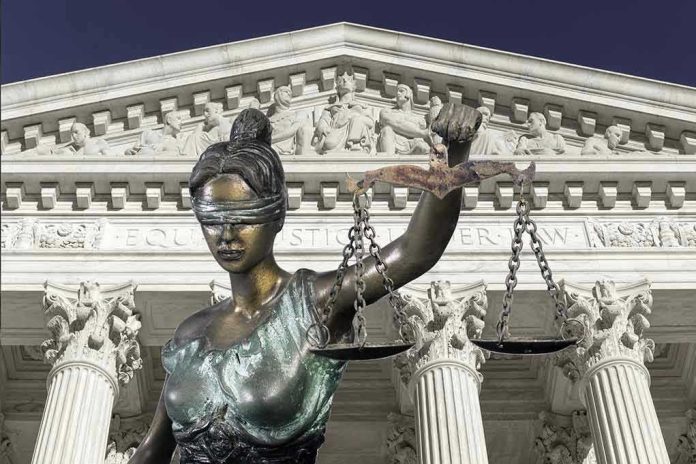
A lifetime-appointed federal judge had sex with a cop in her chambers during work hours, lied about it, kept her job, and taxpayers are expected to pretend the robe still means what it used to.
Story Snapshot
- Federal judge engaged in a two-year extramarital affair with a high-ranking police officer, including sex in chambers during business hours within earshot of staff.[1][4]
- Law clerks reported the conduct, security logs backed them up, and the judge initially called the allegations “outrageous” before admitting the affair.[1][2][4]
- Disciplinary bodies found a “gross lack of judgment,” false statements, and a troubling workplace environment—but issued only a private reprimand.[1][2][4]
- The judge kept her lifetime seat, lost some leadership perks, and was ordered to send apology letters, raising hard questions about judicial self-policing.[2][4][7]
Sex, lies, and a locked courtroom door
Federal investigators concluded that a sitting judge and a high-ranking police officer had “sexual intercourse in the judge’s chambers during business hours within hearing distance of staff.”[1][4] Law clerks described multiple encounters, not a one-off lapse in judgment, and a law clerk’s complaint in 2025 triggered the inquiry.[1][4][6] Security footage and visitor logs showed the officer repeatedly entering chambers in uniform around lunchtime, corroborating the clerks’ descriptions of a pattern, not gossip.[1][2][4]
The affair reportedly ran for roughly two years, blending private infidelity with official power.[4][7] The judge’s partner was not some random acquaintance but a high-ranking member of the Atlanta Police Department, the very kind of law enforcement official whose credibility and relationship with the court can shape prosecutions and plea deals.[2][4] That dynamic sharpened the appearance-of-impropriety problem: when the bench and the badge get this entangled, ordinary citizens are right to ask who, exactly, is policing whom.[4][7]
Lies, recantation, and the ethics of credibility
When confronted, the judge initially labeled the allegations “outrageous” and “baseless,” denying both the affair and the in-chambers sex.[1][2][4] Only after evidence and testimony mounted did the judge recant and admit the extramarital relationship and sexual encounters in chambers, while still disputing broader claims of staff mistreatment.[1][4] Investigators explicitly found that the judge made false statements during the early stages of the inquiry, a direct hit on credibility—the one asset a judge cannot afford to squander.[1][4]
The special committee’s own language was blunt: the conduct showed a “gross lack of judgment” and created a workplace environment that staff found “uncomfortable and troubling.”[4] Clerks reported overhearing sexual sounds, alleged the judge yelled and cursed at them, and said mentoring and editing of their work suffered.[4] The committee also warned that the affair made the judge vulnerable to extortion or blackmail, a scenario any national-security briefing would flag as a serious risk, not a private peccadillo.[4]
Discipline in the shadows and the price of secrecy
After all that, the Judicial Council of the 11th Circuit imposed a private reprimand in February—no name released, no public hearing, no suspension.[1][2][4] The national Committee on Judicial Conduct and Disability upheld the sanction and explicitly cited the judge’s recantation, pledge to avoid future partisan events, and “otherwise exemplary service to the court” as mitigating factors.[1][2][4] In other words, the system found serious misconduct yet still opted for the lightest formal rebuke short of doing nothing.[1][7]
She got a private reprimand (the lightest formal sanction short of removal) from the Eleventh Circuit Judicial Council, upheld May 22, 2026.
She has to write apology letters to the affected clerks, can’t serve as chief judge (she was next in line by seniority), and is barred…
— Pamela (@SaraElae) May 28, 2026
The discipline came with strings but no real loss of power: the judge agreed not to seek the future chief judge role, to avoid Judicial Conference committee work, and to write apology letters to six former law clerks.[2][4] Those are career inconveniences, not consequences that an average government employee would recognize as commensurate with sex on the clock, in the office, followed by lies to investigators. Conservative readers will see the pattern: one standard for insulated elites, another for everyone else.
Judicial self-policing and the trust gap
Public identification came not from the judiciary’s own transparency but from outside reporting that named United States District Judge Eleanor Ross of Atlanta and an Atlanta Police Department deputy chief as the alleged pair, citing a source “familiar with the situation.”[4][7] Official documents still refer to a ghostly “subject judge,” an anonymity that might protect the institution’s image but leaves taxpayers guessing which black robe breached their trust.[1][4][7] That secrecy fuels cynicism about courts as closed clubs.
Defenders argue that the judge showed remorse, ended the relationship, and has a strong performance record, making rehabilitation both possible and preferable to political spectacle.[1][2][4] Yet the core facts align with every reason conservatives distrust unaccountable bureaucracy: sex in a government office during work hours, misuse of staff’s professional environment, provable lies during an investigation, and then a quiet, insider-managed resolution.[1][4][7] When the branch that lectures the country on the rule of law handles its own like this, people stop listening to the sermons.
Sources:
[1] Web – Cop Copulating Judge Reprimanded for Cheating in Chambers on the …
[2] Web – Federal judge remains in office after secret discipline in affair with …
[4] YouTube – Federal judge accused of having sex in chambers
[6] Web – Federal judge chastised for in-chambers affair with cop
[7] Web – Atlanta federal judge reprimanded over affair with officer in chambers