

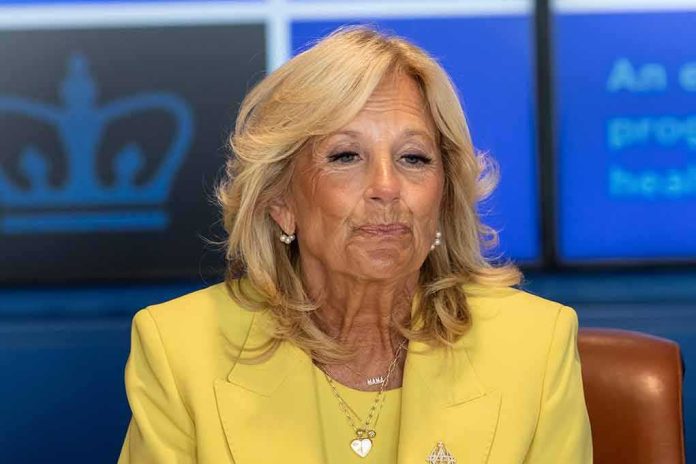
Jill Biden’s glossy CBS defense of Hunter Biden’s pardon did something remarkable: it turned a mother’s plea into a constitutional stress test on whether America still believes in equal justice.
Story Snapshot
- Jill Biden publicly owns that she pushed for Hunter’s pardon because she believes the justice system treated him unfairly and would “target” him under Donald Trump.
- Her defense collides head-on with Joe Biden’s previous pledge never to pardon his son, raising hard questions about trust and political convenience.
- The family frames the pardon as protection from political persecution, while critics see it as proof of elite privilege.
- The interview exposes a growing gap between how ruling families see “fairness” and how ordinary Americans experience the law.
The CBS Interview That Turned Spin Into a Confession
Jill Biden did not just defend her husband’s pardon of Hunter; she laid out the emotional and political logic behind it on national television. In the CBS Sunday Morning interview with Rita Braver, she said she “truly supported” the decision and “wanted him to pardon Hunter at that point,” making clear she was not a bystander but an advocate.[1][2][3][4] That candor stripped away plausible deniability and forced viewers to confront what the pardon really represented: family loyalty taking precedence over a prior public promise.
Jill Biden also acknowledged what every skeptic already suspected: Joe Biden’s position changed. She recalled that “in the beginning” he said “I won’t pardon Hunter. I won’t pardon Hunter,” but then “the Justice Department changed.”[1][3][4] According to her, Donald Trump’s election turned the legal environment into something dangerous, and that shift justified breaking the no-pardon pledge.[2][3][4] That explanation effectively admits the flip-flop and tries to recast it as a reluctant response to a corrupted process rather than a crass act of political self-protection.
The Fairness Claim And The “No One Goes To Jail For This” Defense
The backbone of Jill Biden’s defense is the assertion that “the process was not fair to Hunter.”[2][3][4] She insisted “we just could not let our son go to jail on a charge that no one would go, I mean, no one has ever gone to jail for.”[1][2][3][4] That is a powerful line for television, because it invites viewers to see Hunter not as the president’s son, but as a stand-in for anyone allegedly railroaded by an overzealous bureaucracy. The problem is that she offers no data, no cases, and no formal findings to prove the process was actually unfair.
From a common-sense, conservative perspective, this is where her story weakens. If the core issue is unequal treatment, the natural question is: unequal compared with whom? Jill Biden does not cite similar gun-form or tax defendants who skated while Hunter faced the book.[2] She does not point to a Department of Justice inspector general report or a court ruling flagging misconduct. The argument rests on her perception and fear, not on verifiable proof. That might resonate as a mother, but it is thin ice as a standard for using the most powerful mercy tool in government.
Targeting, Trump, And The Politics Of Preemptive Pardons
Jill Biden’s most explosive claim is that “when Trump was elected, things changed, and we knew that he would target Hunter.”[2][3][4] She extends that logic to explain why Joe Biden also preemptively pardoned several other family members, saying she “suppose[d] for the same reason that he felt that they would be targeted.”[2][3][4] This portrays the Trump-era Department of Justice as an arm of political retribution and frames the pardons as defensive armor against an incoming administration rather than forgiveness for past wrongdoing.
CBS: "President Biden has said that he would never pardon his son."
Jill Biden: "He did."
CBS: "And then he pardoned him."
Biden: "The Justice Department changed… the process was not fair to Hunter."pic.twitter.com/7ljyvfKq8y
— Resist the Mainstream (@ResisttheMS) June 1, 2026
That narrative clashes with how many Americans, especially on the right, view the justice system. Conservatives routinely argue that federal institutions already bend over backward to protect political insiders and their families, not persecute them. Jill Biden flips that script by casting the Bidens as potential victims of selective prosecution while they sit atop the political ladder. Without internal Department of Justice records or directives showing an intent to target Hunter, this sounds less like whistleblowing and more like convenient justification for shielding the family from consequences.[2][3][4]
What The Interview Reveals About Power, Promises, And Trust
Even without external opposition research, the CBS segment itself exposes a credibility problem. Joe Biden repeatedly pledged not to pardon his son; Jill Biden now confirms he did exactly that and that she backed the reversal.[1][2][3][4] In a media environment where trust in institutions is collapsing, that alone is politically damaging. Voters do not need a law degree to see that a clear promise was broken once the personal cost became too high. That looks less like principle and more like insider privilege.
The broader pattern fits what Americans have watched for decades: when ordinary citizens face the system, they get process; when political dynasties face the system, they get explanations. Jill Biden’s interview leans heavily on emotion, fear of Trump, and untested claims of unfairness to justify an extraordinary act of presidential mercy. For citizens who believe in equal justice, that tradeoff is troubling. If “no one has ever gone to jail for this” was enough to save Hunter, many will wonder why it is almost never enough to save anyone without the Biden last name.
Sources:
[1] Web – Jill Biden Defends Hunter Biden Pardon in CBS Interview — Accidentally …
[2] YouTube – Jill Biden says she “truly supported” Joe Biden’s pardon of …
[3] Web – Jill Biden on Hunter pardon: “We just could not let our son …
[4] YouTube – Jill Biden on Joe Biden’s pardon of son Hunter