

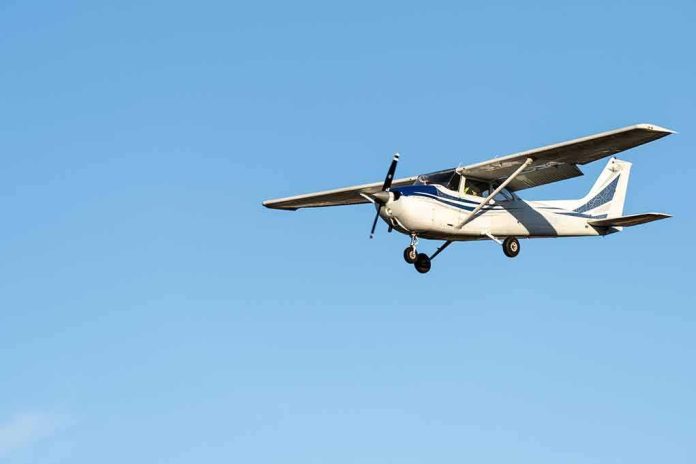
Alaska’s effort to take a bush pilot’s $95,000 plane over a passenger’s six-pack of beer is now a United States Supreme Court test of how far government can go when it wants your property.
Story Snapshot
- A bush pilot faces loss of his $95,000 plane over a passenger’s six-pack of beer, after a misdemeanor conviction.
- Alaska law mandates forfeiture of aircraft used to bring alcohol into “dry” villages, and state courts upheld the seizure as constitutional.
- The trial judge twice said taking the plane would be an “excessive fine,” but higher Alaska courts reversed and ordered forfeiture.
- The United States Supreme Court will now decide whether this kind of automatic forfeiture violates the Constitution’s ban on excessive fines.
How A Six-Pack Turned Into A Fight Over A $95,000 Plane
Alaska bush pilot Kenneth Jouppi was convicted of a misdemeanor after a passenger carried a six-pack of beer on his flight to Beaver, a village that has banned alcohol. The beer was in the passenger’s grocery bag, not in Jouppi’s personal cargo, and there is no record of him running a larger smuggling operation. Under Alaska law, however, any plane used to bring alcohol into a dry community must be forfeited to the state, no matter how small the amount.
State prosecutors asked the trial court to take Jouppi’s 1969 Cessna, valued around $95,000, as part of his punishment. The trial judge refused, first saying the plane had not actually flown toward Beaver yet, so it had not “transported” the beer under the statute. After an appeal, the judge held a full hearing on whether forfeiture would be an “excessive fine” and again ruled that seizing the plane would go too far for a first-time misdemeanor involving one six-pack.
Why Alaska’s Courts Said The Seizure Was Not “Excessive”
Alaska’s Court of Appeals and then the Alaska Supreme Court stepped in and saw the case very differently. The appeals court sent the case back, telling the trial judge to build a fuller record under United States v. Bajakajian, the leading Supreme Court case on excessive fines and forfeiture. When the issue reached the Alaska Supreme Court, the justices said no more fact-finding was needed and held “as a matter of law” that taking the plane was not unconstitutionally excessive.
Justice Jude Pate, writing for a unanimous court, focused heavily on the broader harms of alcohol in rural Alaska. The opinion cited high rates of crime, alcoholism, fetal alcohol spectrum disorder, and deaths linked to illegal alcohol in villages. From that view, even a single six-pack brought by an air taxi pilot was seen as part of a serious social problem, and the court said this “factor strongly suggests that the forfeiture is not grossly disproportional” to the offense.
The Excessive Fines Clause And What The Supreme Court Must Decide
The United States Constitution’s Eighth Amendment bans “excessive fines,” and in recent years the Supreme Court has said that rule applies to state and local governments, not just Washington. The Alaska Supreme Court agreed that taking Jouppi’s plane is a punitive sanction and therefore a “fine” covered by the Eighth Amendment. But the state court still found the punishment acceptable, saying the loss of the plane was not “grossly disproportional” once the wide community harms of bootlegging were considered.
✈️ Pilot Challenges Alaska’s Plane Confiscation
🍺 Alaska bush pilot Kenneth Jouppi was convicted after a passenger carried a six-pack of beer aboard his 1969 Cessna for a flight to Beaver, a community where alcohol was prohibited. Troopers found the beer before takeoff in April… pic.twitter.com/hbf9WrB8Xe
— Knowledge Ocean News (@marlin_wizard) July 20, 2026
Jouppi’s lawyers, including the public interest firm Institute for Justice, argue that Alaska looked at alcohol harm “in the abstract” instead of at his actual conduct. They stress that he faced only a small jail term and fine, had no record of past smuggling, and that the beer belonged to a passenger. From their view, taking a working man’s main tool for earning a living over one six-pack shows how modern forfeiture laws let government grab property first and ask fairness questions later.
Why This Case Resonates Far Beyond One Pilot In Alaska
This dispute does not stand alone. Alaska has a pattern of strict, often automatic forfeiture in dry-village alcohol cases, seizing vehicles and planes with little room for judges to weigh the size of the offense or the owner’s livelihood. Nationally, critics across the political spectrum worry that civil and criminal forfeiture let officials finance their agencies by taking property, while ordinary people face years of costly court battles just to keep what they worked for.
For conservatives and liberals alike who feel the system favors the powerful, a fourteen-year fight over a six-pack looks like proof that everyday people can be crushed by complex rules and aggressive enforcement. If the Supreme Court sides with Alaska, states may read that as a green light to keep or expand mandatory forfeiture, even for minor crimes. If the court rules for Jouppi, it could force governments to match property seizures more closely to the actual harm and to the person’s role, not just to the worst-case stories officials can tell.
Sources:
nypost.com, alaskabeacon.com, supremecourt.gov, alaskapublic.org, law.justia.com, finesandfeesjusticecenter.org, alr.law.duke.edu, thealaskastory.com, newsweek.com