

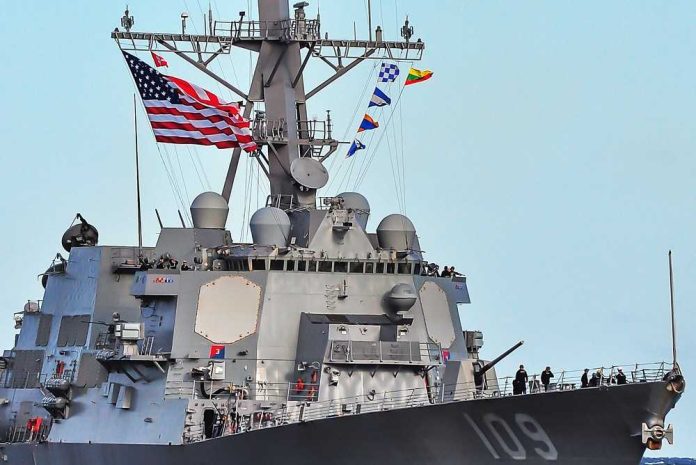
The U.S. Navy has now put in writing a plan to turn data and artificial intelligence into weapons of war, even though its own leaders admit the technology is not ready everywhere it counts.
Story Snapshot
- The Navy signed a formal strategy to “weaponize” data and artificial intelligence across the fleet.
- The plan sets six clear goals, from better data to AI-ready ships and bases.
- Real-world use is still spotty, with big gaps in autonomous weapons and fleet-wide integration.
- Ethical worries and lack of hard performance proof fuel fears that elites are racing ahead without real accountability.
Navy Makes AI Weaponization Official Policy
Acting Secretary of the Navy Hung Cao has formally signed a “Strategy to Weaponize Data and Artificial Intelligence,” making AI-driven warfare an official goal of the service. The Navy says this plan will speed up military decisions and help the United States keep control of the seas as rivals like China and Iran grow stronger. For many Americans, this sounds like another grand promise from Washington at a time when trust in federal leaders is already badly strained.
The signed strategy is not just a speech; it lays out six concrete goals for changing how the Navy fights. These include improving how ready Navy data is for use, speeding up how fast AI tools reach ships and units, strengthening the digital pipes and hardware that move data, streamlining rules and oversight, building a skilled workforce, and partnering more closely with private industry. On paper, this is a sweeping attempt to turn every sensor and database into an edge in combat.
What the Strategy Really Does on the Ground
The Navy and Marine Corps are trying to back this vision with specific technical changes, starting with how they handle data. The Marine Corps Artificial Intelligence Implementation Plan, known as NAVMC 3000.1, calls for a “data fabric” that lets trusted users pull the right data in real time, built on a Zero Trust security model and fine-grained access controls. This matters because no AI can work well if the military’s own data is locked in silos or unsafe from hacking and insider abuse.
Navy Fleet Forces Command is also working to standardize the tools, training, and certifications sailors need to use AI in the real world. The goal is “decision advantage,” meaning commanders see threats and options faster than enemies do. This includes shared software environments, common data formats, and training pipelines so that AI systems are not just science projects but part of normal fleet operations. In theory, this should cut down on the chaos and duplication that often plague big government tech pushes.
Early Uses: Mines, Submarines, and Autonomous Systems
Some early uses of AI show how powerful these tools could be, if they work as promised. The Navy has turned to a private firm, Domino Data Lab, to help refresh mine-detection models in days instead of the usual six months, under a contract reported at around $100 million. Faster updates could matter in places like the Strait of Hormuz, where a single smart mine could block vital oil flows and hit both American drivers and global markets.
The Navy is also moving from old-style minesweeping to autonomous systems, such as unmanned undersea vehicles and large autonomous surface vessels, in contested waters. In one documented case, Navy teams used “optimal motion analysis,” a form of predictive modeling, to locate damage to a submarine without relying on standard sonar, shrinking a huge search area down to a small zone. These examples support the idea that smart use of data can save time, reduce risk to crews, and sharpen the military’s response when things go wrong.
Big Promises, But Thin Proof and Real Capability Gaps
Despite the bold language, there is still no public set of hard numbers showing that this strategy has truly sped up decisions across the fleet or locked in sea control. The Navy’s documents and speeches talk about faster choices and smarter weapons, but they do not provide before-and-after comparisons, fleet-wide metrics, or independent audits that citizens can check. This fits a wider pattern: a 2024 RAND study found the Department of Defense’s posture in artificial intelligence “significantly challenged” and lacking clear baselines to measure real progress.
Senior Navy voices admit that many key systems are not yet where they need to be. The Chief of Naval Operations has pointed to shortfalls in autonomous weapons, problems tying unmanned drones together across air, sea, and undersea domains, and a lack of large “mothership” platforms to carry and support these systems. Fleet-wide integration is still limited; some strike groups have tested large autonomous vessels, but this is far from a fully AI-enabled Navy. In other words, the strategy races ahead of the actual hardware and software.
Ethical Fears, Public Skepticism, and the Deep State Question
Outside the technical world, the idea of “weaponizing” data and AI touches deep fears held by citizens across the political spectrum. A Navy article itself notes worries about loss of human agency, misuse of data, job loss, and dependence on autonomous systems. Yet the public version of the new strategy focuses on technical and operational goals, not clear rules for keeping humans in charge or preventing abuse. That gap feeds the belief that elites inside the “deep state” are reshaping war without real consent or safeguards.
Human rights groups warn that military AI is being fielded faster than it is properly tested and checked for safety and legality. RAND and other experts say the Defense Department lacks the metrics, talent, and oversight needed to prove that these systems work as claimed and stay under human control. At the same time, the strategy leans heavily on industry partnerships but offers little public detail on vendor selection or conflicts of interest. For many Americans, this looks less like careful national defense and more like another massive tech program where insiders win contracts while ordinary people carry the risks.
Why This Matters for Everyday Americans
The Navy’s AI weaponization plan ties directly into larger worries about government failure that both conservatives and liberals share. Conservatives see yet another grand strategy built by bureaucrats and contractors who rarely face real accountability when projects slip, misfire, or waste billions. Liberals see growing use of powerful surveillance and killing tools at a time when many feel the gap between rich and poor, and between those with power and those without, keeps getting wider. Both sides worry the government talks about safety and values but hides performance data behind classification stamps.
Geopolitics makes this pressure even worse. China’s growing reach, including major port projects that can bypass U.S. control, pushes military leaders to move faster, sometimes before systems are fully proven. When the Navy says it must weaponize data and AI to keep up, many citizens hear an echo of past promises on globalism, energy policy, and forever wars that did not deliver for ordinary families. Whether this strategy becomes a real defense tool or just another elite-driven project will depend on something simple but rare in Washington: honest metrics, open debate, and clear lines that keep machines serving human judgment, not replacing it.
Sources:
insidedefense.com, breakingdefense.com, marines.mil, doncio.navy.mil, navy.mil, youtube.com, defenseai.eu, fedtechmagazine.com, bundeswehr.de, ccdcoe.org