

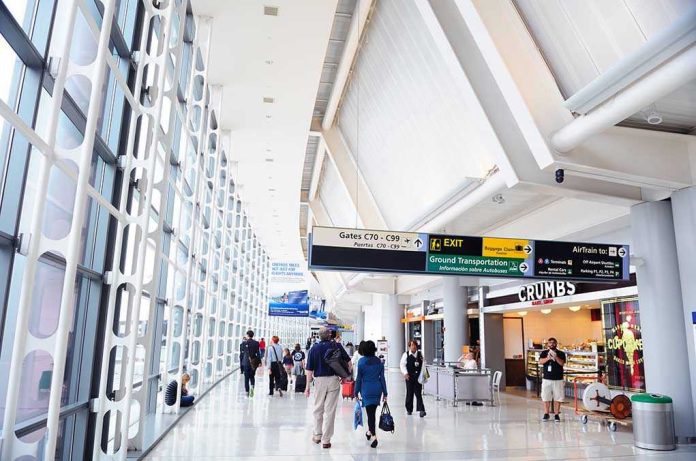
A late-night carry-on bag at Sacramento International Airport allegedly held a homemade explosive, five taped-over phones, and a message chilling enough to raise the question no traveler wants to ask: how close did this come to disaster?
Story Snapshot
- Federal prosecutors say a Sacramento man tried to take a viable explosive through airport security.
- Transportation Security Administration screening allegedly uncovered a flash-powder device, weapons, and multiple cell phones.[3][1]
- Investigators claim the device could have damaged an airplane window and depressurized the cabin.[2][3]
- The case shows how much power prosecutors have to define the narrative long before a jury sees a single piece of evidence.
An ordinary checkpoint, an allegedly extraordinary bag
Federal prosecutors say that on the night of May 30, 2026, 49-year-old Sacramento resident Kimani Osayande Jones walked into Sacramento International Airport and headed for the security checkpoint like any other traveler.[3][1] Transportation Security Administration officers allegedly spotted something suspicious in his carry-on during routine screening and pulled the bag for closer inspection.[1] What they say they found inside turned a standard security line into the opening scene of a federal explosives case.[2]
According to the United States Attorney’s Office for the Eastern District of California, the bag allegedly held an “M-type” improvised explosive device built with flash powder and a fuse, along with a torch-style lighter.[3][1] Media reports add that officers also discovered a knife, scissors and loose scissor blades, an aerosol can, zip ties, and five cell phones, several of them with their front cameras taped over.[1][2] Federal agents and county bomb technicians removed the device from the airport for testing, and Jones was arrested on the spot.[1][3]
What prosecutors say the bomb could have done
The Department of Justice press release states that a bomb technician with the Federal Bureau of Investigation examined and tested the device and concluded it contained viable explosive powder and a functional fuse.[3] A television report quoting federal documents says the device was powerful enough to damage an airplane window if detonated at altitude.[2] That matters because a failed window can rapidly depressurize the cabin, turning a small package in a carry-on into a potentially catastrophic in-flight event.
Prosecutors charged Jones with unlawfully possessing explosive material in an airport, a federal crime that does not require an actual detonation or even an attempt to board a plane.[3] The allegation focuses on knowingly bringing explosive material into the secure area. Officials also highlighted the alarming combination of items: an energetic device, weapons, cutting tools, zip ties, and multiple phones.[1][2] For a public already conditioned by years of terrorism scares, that bundle almost writes its own storyline, whether or not it holds up to full evidentiary scrutiny later.
The ominous phones and the missing defense narrative
Coverage of the criminal complaint says investigators seized five cell phones from the bag, one of which allegedly displayed a fifteen-minute timer and a screen message that observers described as ominous.[2] Reporters paraphrased that language as suggestive enough to imply planning rather than accident, feeding the idea that the phones might be more than travel clutter. Prosecutors have not publicly said that any phone was physically wired to the device, but they clearly see the digital evidence as part of an intent story, not just a baggage-inventory list.
The public record right now is lopsided. The government has spoken through a detailed press release and a criminal complaint, while the defense side has, at most, a lawyer reminding everyone that Jones is presumed innocent.[3][1] There is no public filing from an explosives expert disputing whether the device was truly “viable,” no alternative explanation for the phones, and no sworn statement describing how those items ended up in the bag.[1] That silence does not prove guilt, but it allows the prosecution’s narrative to stand largely unchallenged in the court of public opinion.
Security fears, conservative instincts, and due process
Airport bomb allegations hit the deepest security nerves in the American psyche, and for understandable reasons: nobody wants leniency at the checkpoint to be the weak link that costs lives. A conservative instinct prioritizes strong borders, strong policing, and serious consequences for anyone who knowingly brings potential weapons into crowded public spaces. From that vantage point, the Transportation Security Administration screeners and federal agents did exactly what citizens expect when they see a bag with a suspected explosive device.[1][3]
Another conservative instinct, though, demands skepticism about government narratives and insists on due process before branding someone a would-be bomber. Complaints and press releases are advocacy documents, not neutral histories. The smarter approach is a two-track mindset: insist on aggressive prevention at the airport door while also insisting that the government prove not just that a scary-looking device existed, but that it was functional and carried with criminal intent. This case will test whether that balance still holds when fear walks through the metal detector.
Sources:
[1] Web – Man nabbed with bomb in California airport
[2] Web – Sacramento man facing explosives charge after SMF arrest
[3] Web – Sacramento man found with explosive during airport security check …