
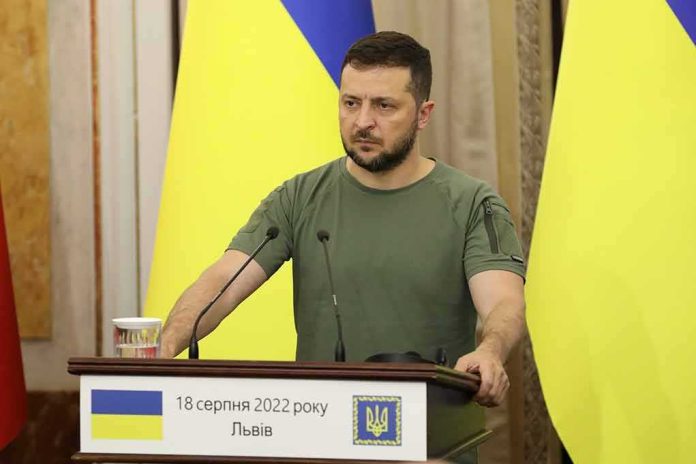
Under street pressure and wartime strain, Ukraine’s president fired his top general and rushed in a replacement.
Story Snapshot
- President Volodymyr Zelensky removed Commander-in-Chief Oleksandr Syrskyi and named Mykhailo Drapatyi.
- Days of protests urged change, citing a rigid “Soviet-style” command culture under Syrskyi.
- Supporters cast Drapatyi as a modernization pick; hard proof of battlefield gains is not public.
- The record shows political pressure shaped the move, while key military data remains classified.
Zelensky Replaces Ukraine’s Top General Amid Protests
President Volodymyr Zelensky dismissed Commander-in-Chief Oleksandr Syrskyi and appointed Mykhailo Drapatyi to lead Ukraine’s armed forces. Major outlets reported the change after days of street protests demanding Syrskyi’s removal. Reports said demonstrators linked Syrskyi to costly tactics and wanted a fresh approach. Coverage from Kyiv-based and international reporters tied the timing to the public outcry, even as the war with Russia grinds on with high stakes along the eastern front.
News accounts said Zelensky’s team framed the shake-up as part of needed reform. Critics of Syrskyi accused him of micromanagement and a top-down command culture that valued holding positions over soldiers’ lives. Deutsche Welle and other reports echoed those claims and described Drapatyi as more open to modernization. Those claims reflect a public narrative, not a released reform plan or directive from Drapatyi that sets specific steps and deadlines.
What Is Known Versus What Is Still Opaque
The facts that are clear: Zelensky signed off on the change; protests were large and sustained; and Drapatyi is now in charge. The parts that remain unclear are also important. There is no public, primary-source data showing Syrskyi’s removal will improve battlefield results. Reporters did not cite declassified metrics, after-action reviews, or a formal reform order that maps to measurable goals. That gap limits outside testing of the move’s promised benefits.
Reports also show that the debate over command culture is not new in Ukraine. Leaders have rotated chiefs before, often citing modernization and reform needs. In 2024, Zelensky replaced General Valerii Zaluzhnyi with Syrskyi, also amid talk of shifting doctrine. This latest change fits that pattern: a wartime leader using personnel moves to signal accountability and momentum, even as the hard evidence sits behind classified walls during an active conflict.
Why This Matters Beyond Kyiv
American readers see a familiar tension: leaders justify big changes as reform, while the public worries about politics and transparency. Many citizens on the right and left believe powerful insiders make the real calls and then feed talking points to the public. This story tracks with that concern. The protest pressure is visible. The internal memos, data, and tradeoffs are not. That makes trust harder to sustain, even if the decision proves sound over time.
🚨Zelensky sacked top #Ukrainian general in biggest military shake-up since '24.
He chooses 43-year-old Mykhailo Drapatyi to replace Syrsky in generational shift in 🇺🇦military leadership.
It's the expected move for Zelensky spoke about removing both to stop the infighting⬇️ pic.twitter.com/wG30fJ7nLr
— 🇺🇸 🇺🇸 🇺🇸Midobecker 🇺🇸 🇺🇸 🇺🇸 (@midobecker_1) July 21, 2026
For Ukraine’s troops, the stakes are concrete. A commander sets tempo, risk, and how much initiative lower units get. If Drapatyi backs faster field adaptation, better casualty management, and clearer mission orders, soldiers could feel it fast. If the change was mainly about politics, front-line units could see churn without gains. Until Kyiv releases a credible reform outline or produces results, outside observers will judge the decision mostly by outcomes on the ground.
Sources:
zerohedge.com, youtube.com, nytimes.com, theguardian.com