
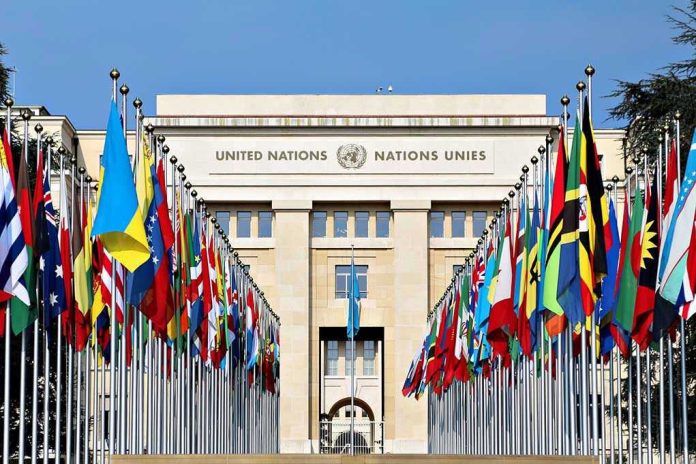
America’s envoy walked out of the United Nations chamber as France accused the United States of failing human rights leadership, sharpening a rift between close allies over a high-profile vote.
Story Snapshot
- U.S. diplomats exited a Security Council meeting as France began remarks on U.S. human rights voting.
- France’s critique followed U.S. opposition to extending the United Nations human rights chief’s term.
- Deputy Ambassador Dan Negrea called France’s speech “disingenuous grandstanding” after the walkout.
- Walkouts are a common diplomatic protest tool at the United Nations across many disputes.
What Prompted the Walkout
U.S. diplomats left a United Nations Security Council meeting when the French ambassador began to speak. France had criticized the United States for opposing an extension of the United Nations human rights chief’s term and reportedly compared Washington’s stance to authoritarian states. The walkout signaled a protest of France’s charge and tone, not a rejection of the meeting’s human rights topic. The sequence and trigger were described by multiple outlets, which called the move rare but clear in intent.
After returning, Deputy U.S. Ambassador Dan Negrea said the United States has stood by France “in every conflict where their freedom has been imperiled.” He called the French remarks “disingenuous grandstanding,” framing Paris’s critique as theater rather than substance. That response aimed to flip the moral claim back on France and to defend U.S. credibility on rights and alliances. The comment captured Washington’s view that France’s language crossed a line in a sensitive forum.
France’s Critique and the Policy Dispute
France tied its criticism to a specific vote on extending the United Nations high commissioner for human rights, Volker Türk. Reports said French diplomats grouped the U.S. position with countries often accused of abuses, which intensified the clash. The United States rejected that framing. The dispute did not center on whether human rights matter, but rather on whether Washington’s vote undercut the office’s mandate and global standing. Direct transcripts of France’s full remarks were not provided in the cited reports.
The fight sits inside a longer history of tension between Washington and United Nations human rights bodies. U.S. leaders have at times argued these bodies are biased or target allies unfairly. In 2018, the United States withdrew from the United Nations Human Rights Council over those concerns, saying it would not be complicit in institutions it viewed as flawed. That move still shapes today’s arguments about U.S. intentions and consistency on rights policy.
Walkouts as a Diplomatic Signal
Delegations often use walkouts to show sharp disapproval without breaking rules. The tactic is blunt, visible, and fast. It tells other members where a red line is, while keeping the door open to return and respond on the record. The United States, European states, and others have used walkouts in disputes with Russia and other speakers. These patterns show that exits are part of the United Nations playbook when speeches are seen as hostile or out of bounds.
For Americans watching at home, the scene can feel familiar. One side claims moral high ground. The other side calls out hypocrisy and showmanship. Both sides speak to their base. People on the right see a partner nation lecturing the United States while ducking its own lapses. People on the left see a warning that great powers bend rules on rights when it suits them. Many in the middle see a global club that talks more than it solves problems.
Why This Matters Beyond Diplomacy
The United States and France are treaty allies with deep ties in Europe, Africa, and the Middle East. When they clash in public at the United Nations, rivals notice. Disputes over who leads on human rights can weaken joint pressure on abusers and muddle messages to reformers. At the same time, sharp debate can test whether these institutions can handle honest disagreement without breaking trust. That balance will shape the next rights fights at the Security Council.
Sources:
insiderpaper.com, news24.com, aa.com.tr, devdiscourse.com, apnews.com, 2001-2009.state.gov