
On Election Day, ballot scanners failed across Westchester County while Florida floods forced polling-site moves, testing whether backup plans could keep votes on track.
Story Snapshot
- Westchester County scanners stopped accepting ballots; voters used emergency paper ballots for later counting.
- Reports pointed to a ballot mismatch with scanner programming as officials rushed replacement media.
- South Florida flooding triggered relocations for dozens of precincts and brief tech issues in Broward County.
- Officials said ballots stayed secure and that voters were not issued wrong ballots during Broward’s outage.
Countywide Scanner Failure Led to Emergency Ballot Procedures
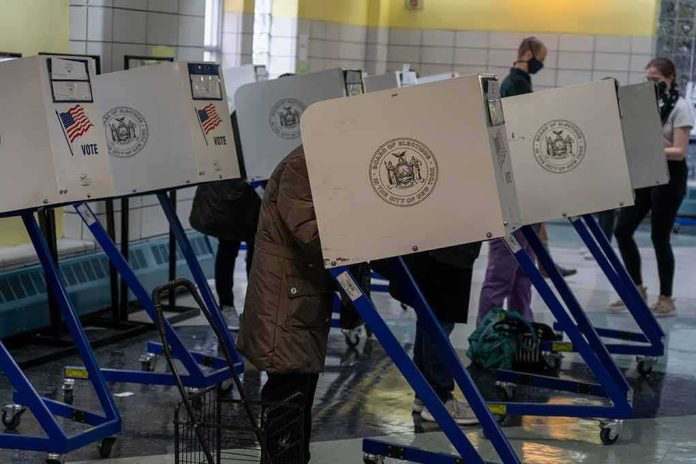
Westchester County’s Board of Elections said a paper ballot issue kept machines from accepting ballots countywide. Officials directed voters to fill out paper ballots and place them in sealed orange emergency ballot bags for later counting under standard rules. United Press International reported that every scanner in the county stopped accepting votes and that the cause was not immediately clear. Poll workers continued to process voters using emergency procedures at sites across the county.
Local reporting added a likely technical reason. The Journal News described a printing glitch that made ballots incompatible with scanners and later noted that scanners running original programming could not read the ballots in use. State officials sent replacement election media to restore normal tabulation on site. The Examiner News said ballots were rejected in 44 of 45 municipalities and cited a county leader who linked the problem to a barcode error on preprinted ballots.
Scope, Impact, and What Officials Promised Next
The disruption was large in scope, touching nearly all municipalities in Westchester, but the exact number of delayed voters was not reported. The county’s statement stressed that emergency ballots would remain secure and be counted under state procedures. That assurance aligned with United Press International’s account that officials safeguarded ballots during the scanner outage. Local outlets tracked lines and site-level fixes, but did not publish queue times or a tally of affected ballots that day.
The record did not name a single confirmed root cause in the first official notice. Later reports used different terms, including a printing glitch, barcode error, and outdated scanner programming. Those may describe linked parts of the same failure, from ballot design to scanner configuration. What remained consistent was the remedy: use emergency paper ballots, secure them in designated bags, and swap in corrected election media to resume scanning once available.
Flooding Forced Florida Polling-Place Moves and Early Tech Fixes
In South Florida, heavy rain and flooding led officials to relocate polling places under emergency rules. Public radio in Miami reported that alternative sites covered 21 original locations affecting 30 precincts because buildings or roads were flooded or unsafe. Officials cited state law that requires a usable, accessible site when the original location is not safe or reachable. These moves aimed to keep in-person voting open despite damaged or blocked facilities.
🗳️ Voting Machine Malfunctions Spark Alarm Across Westchester County, New York
🚨 Election Day Disruptions: Reports of malfunctioning ballot tabulators across Westchester County, New York, have raised concerns among voters as Americans head to the polls for the midterm…
— Washington Report (@Washington_Rep) November 3, 2026
In Broward County, local news said voters from the Paradise Village site were redirected to Tree Tops Park, and Precinct E10 moved to Mullins Hall. A separate technical issue briefly disrupted early voting operations. The county elections office said the failed feature was designed to ensure voters received the right ballot. Officials reported that voters were not given the wrong ballot and asked anyone who left during the outage to return before polls closed at 7 p.m..
Why These Disruptions Matter for Access and Confidence
Election systems have many moving parts. Ballot design, scanning software, poll books, and logistics must work together. Research shows that technology can fail for reasons outside a local office’s full control, including vendor or network problems. When sites move because of floods or other hazards, travel time and confusion can lower in-person turnout, even if the law allows quick relocations and officials give notice to voters. Those access costs can shape who votes and how long they wait.
The key test on days like this is whether backup plans protect both access and evidence. In Westchester, that meant using emergency ballot bags, then reconciling and counting those ballots under the same rules used after any scanner outage. In Broward, that meant steering voters to safe sites and fixing the ballot-assignment feature quickly while confirming no one got the wrong ballot. Clear records, accurate counts, and prompt public updates help close the loop after the rush.
Bottom Line for Voters and Officials
Voters saw real problems and real workarounds on the same day. Westchester relied on emergency paper ballots as technicians updated scanner programming. South Florida moved polling places away from flood zones and resolved a brief technical outage without issuing wrong ballots. These steps follow established playbooks for keeping elections running. The practical measure of success is simple: every eligible voter can cast the correct ballot, and every valid ballot is counted as cast.
Sources:
pjmedia.com, westchestercountyny.gov, cbsnews.com, upi.com, wlrn.org, lohud.com, theexaminernews.com