

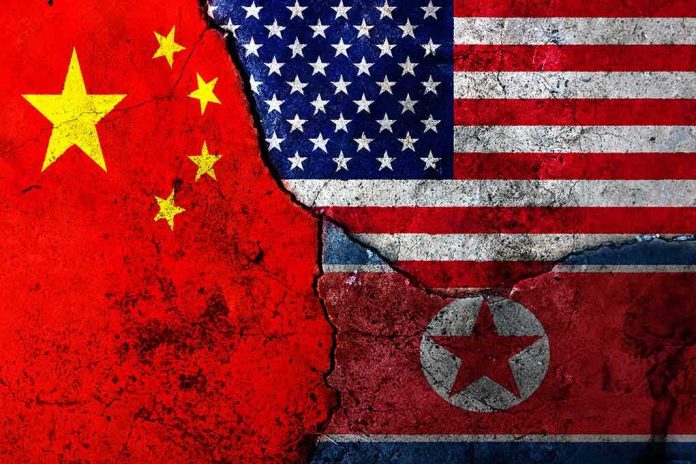
President Trump said Kim Jong Un “may come” to a China gathering with him, putting Beijing in control of a high-stakes meeting’s fate.
Story Snapshot
- Trump said he and Kim Jong Un might meet in China during his Asia trip.
- Reports said Trump, Xi Jinping, and Vladimir Putin planned to gather in Shenzhen around the APEC summit.
- Trump said Kim’s attendance was “up to President Xi,” with no set format.
- A senior U.S. official earlier said there were no plans to engage North Korea during the trip.
Trump Floats Possible China Meeting With Kim Jong Un
President Trump told reporters before leaving for Asia that he and North Korea’s Kim Jong Un “may meet” in China. He added that Kim “may come,” but said the decision rested with China’s leader, Xi Jinping. Trump did not say whether any contact would be a side meeting or tied to a larger session. The White House did not release a schedule for such a meeting. North Korea and China did not issue matching statements.
Contemporaneous reports described a planned gathering in Shenzhen involving Trump, China’s Xi Jinping, and Russia’s Vladimir Putin alongside events linked to the Asia-Pacific Economic Cooperation summit. Those accounts placed any Trump–Kim contact on the margins of that stop. They also left unclear whether Kim would join a three-way session or meet Trump separately if invited by China. Trump’s wording stressed that China would decide who sat at the table.
Host-Nation Leverage And Unsettled Logistics
Trump’s comment that Kim’s role was “up to President Xi” made China the gatekeeper. That aligns with standard protocol: the host nation controls invitations, security, and space. It also gives Beijing sway over what is discussed and when. Reports said neither Washington nor Pyongyang confirmed a meeting plan or agenda. The format, timing, and length were all left open. That ambiguity suggests security and logistics would be the first hurdles to clear.
Earlier messaging from a senior U.S. official said there were “no plans at all for engagement with North Korea” during the trip. Trump’s on-camera remarks created a new possibility, but not a commitment. Such conditional summit signaling is common in high diplomacy. Leaders often test the waters in public while staff gauge interest and prepare options. That approach draws attention, but it can also raise expectations before negotiators align on goals.
Strategic Stakes And Lessons From Past Summits
A China venue that included Trump, Xi, and Putin would place North Korea’s nuclear issue inside a wider power triangle. That setting could offer diplomatic cover for limited steps, such as military-to-military hotlines or missile test pauses. It could also dilute focus if many issues compete for time. In 2018 and 2019, Trump and Kim met three times. Those meetings lowered tensions and opened channels, but they did not produce a tested denuclearization plan.
Analysts and official reviews note a pattern. Leader-level meetings are easier to arrange and promote than the grinding talks needed to define limits, inspections, and trade-offs. The 2019 period showed how fast momentum can stall when sides disagree on sanctions relief, scope of nuclear assets, and verification steps. If a China contact occurs now, progress will likely hinge on whether working-level teams can lock in concrete steps after the photo lines.
Why This Matters For Americans Across The Spectrum
Americans on the right and left worry that global deals are stagecraft while real threats grow. A quick summit can look like a win, but a weak one may waste time and reward bad actors. Supporters see face-to-face talks as a low-cost way to reduce risk. Critics fear loose promises and unclear red lines. The shared concern is practical: will any meeting curb missiles, protect allies, and keep U.S. forces out of another crisis without giving away leverage?
🇺🇸🇨🇳 TRUMP SAYS HE WILL ATTEND APEC IN CHINA
Donald Trump said he will travel to China for the APEC summit. Meetings with Xi Jinping and Vladimir Putin are planned, while a meeting with North Korea's Kim Jong Un is possible.
Writer: AB Kuai․Dong
pic.twitter.com/CtLbCYkGqh— Alex Bennett (@AlexBennett126) November 17, 2026
Trump’s statement put the ball in China’s court while keeping options open. That preserves flexibility for the United States and raises pressure on Beijing to own the outcome. It also signals to Pyongyang that status comes with conditions. If China invites Kim and a meeting happens, watch for modest, verifiable steps, not sweeping pledges. If no invite comes, the message will be clear too: Beijing chose not to open that door this time.
Sources:
youtube.com, rappler.com, lbcgroup.tv, n.news.naver.com, fr.jpost.com, congress.gov