

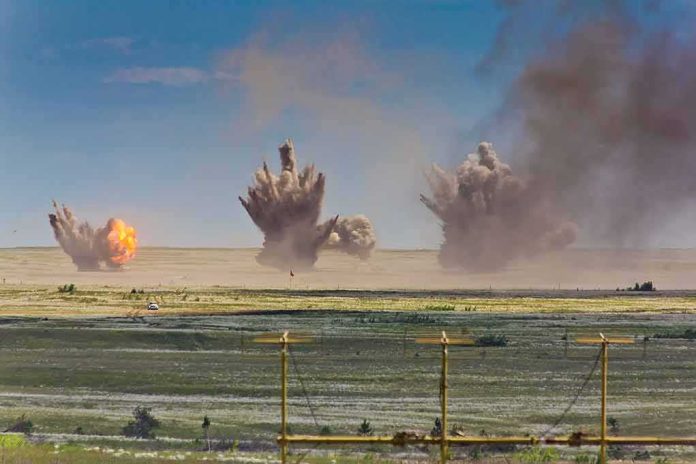
After days of legal twists and public warnings, the Army says unstable explosives in Iowa may need to be blown up on-site to avoid a worse disaster — with an emergency permit and a backup legal path already in hand.
Story Highlights
- The Environmental Protection Agency issued an emergency permit for on-site detonation of degraded lead azide at an Iowa Army plant.
- A court fight briefly paused the plan, but filings show the Army prepared to invoke a separate emergency exclusion if needed.
- Environmental groups argued safer options were not fully vetted and sought more public information.
- Officials say in-place detonation addresses an immediate risk from unstable material and reduces chance of an uncontrolled blast.
What the Army Plans and Why It Says Time Matters
The U.S. Army identified 68 drums of degraded lead azide at the Iowa Army Ammunition Plant in Middletown. Lead azide is a primary explosive that can detonate from heat, friction, or shock when it degrades. The Environmental Protection Agency (EPA) issued an emergency permit effective November 13, 2026, to store and treat the material by intentional in-place detonation at a location outside the plant’s normal permit area. The Army says this approach reduces handling and lowers the risk of a sudden, uncontrolled explosion.
The Army publicly postponed an initial detonation date to allow more safety preparations. Leaders said public safety is the top priority and pointed to falling temperatures as a factor that can increase instability in degraded explosives. Lead azide’s chemical breakdown can make movement dangerous, which is why officials favored in-place treatment instead of transport. Federal rules allow emergency actions for immediate explosive threats, alongside normal hazardous waste permitting.
The Permit, the Pause, and the Emergency Backup
Environmental groups challenged the EPA’s emergency permit in federal court, and a brief administrative stay paused the plan. The court later lifted the stay, returning the permit to effect, but legal filings show the Army also prepared to invoke a separate “emergency munitions and explosives” exclusion if conditions worsened, allowing action even without the emergency permit. The government notified the court of this intent, citing an immediate threat and the need to protect nearby communities.
EPA’s emergency permit spells out controls for the detonation and handling area. The authorization recognizes lead azide as both reactive and toxic because of its lead content. The permit confines the action to a specific site and requires steps to limit off-site impact, consistent with emergency hazardous waste rules. EPA’s public notice confirms the permit scope and its November 13 effective date, documenting the agency’s review and rationale.
Why Critics Object and What They Want Disclosed
The Iowa Environmental Council and allied groups argued that alternatives to open detonation were not fully considered before the Army moved forward. They pressed for more details on health risks and cleanup plans, and they asked the court to halt the operation while those questions were addressed. Their push reflects a broader view that open detonation should be a last resort when safer, enclosed methods may be possible, even if they take more time to set up.
Reporters and local officials highlighted public anxiety over possible lead dust if a plume travels beyond the site. Those concerns led to precaution guidance in neighboring states and calls for more transparency. While the Army and EPA point to emergency authority for fast action, advocates argue the community needs clear, timely data and plain-language risk explanations before, during, and after any detonation.
How This Fits a Bigger National Pattern
Federal policy has long balanced two realities: unstable explosives can become more dangerous if moved or stored too long, but open detonation can release toxins. The Resource Conservation and Recovery Act sets up two tracks to manage that tension. One is normal permitting for open burning or open detonation. The other is emergency authority for immediate explosive threats when delay could raise the risk of an uncontrolled blast.
The Iowa case shows that clash in plain view. On one side, Army specialists warn that degraded material can trigger without warning, demanding quick, on-site action. On the other, residents and environmental groups want proof that every safer alternative was vetted and that health protections are real, not just promised. Both impulses are rooted in public safety. Clear data, steady updates, and independent checks can help rebuild trust as the government carries out dangerous work near people’s homes.
Sources:
ecf.ca8.uscourts.gov, epa.gov, courtlistener.com, desmoinesregister.com, response.epa.gov, army.mil