

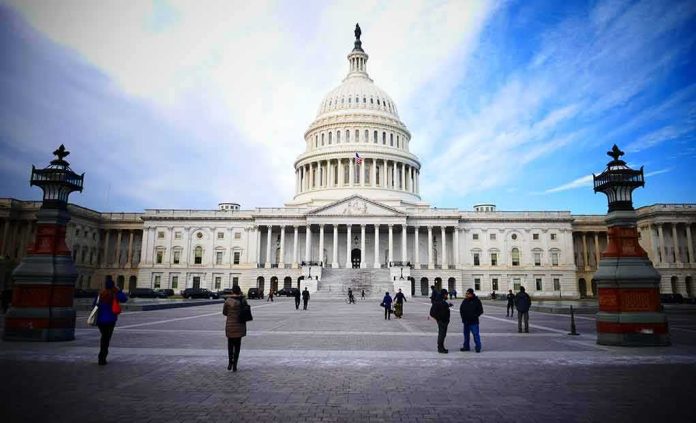
House Democratic Leader Hakeem Jeffries refused to rule out opposing short-term funding over Iran-war limits as a shutdown deadline neared, sharpening a high-stakes budget fight.
Story Highlights
- Jeffries declined to commit to a clean funding patch before the December 11 deadline.
- Four Democratic senators threatened to block a short-term bill without Iran-war restrictions.
- Republicans rejected tying routine funding to limits on the president’s Iran operations.
- The debate fits a long pattern of using spending bills for non-budget fights.
What Jeffries Said And Why It Matters
Hakeem Jeffries told reporters that Democrats were still negotiating priorities ahead of a December 11 funding lapse. Jeffries did not promise support for a clean short-term bill, leaving open whether Democrats would accept shutdown risk to seek limits on Iran-war spending. He described the war as reckless and said House Democrats opposed more money for the “war machine” in the Middle East. The stance raised pressure on leaders as the calendar tightened and routine funding grew entangled with war policy.
Jeffries’s refusal to commit did not equal a vow to force a shutdown. Reporting stressed the ambiguity. Democrats debated tactics, including a temporary extension that would move talks into next year. That nuance matters because leverage does not guarantee the caucus would use it. Still, a hard deadline always raises risk. When Congress hesitates, agencies prepare for possible furloughs, paused services, and late pay—costs that land on workers and families first, not on political leaders.
The Senate Push For Iran-War Restrictions
Senators Michael Bennet, Bernie Sanders, Chris Van Hollen, and Tammy Duckworth said they would oppose a short-term funding bill unless it restricted money for continued U.S. operations against Iran. Their move linked must-pass funding to war policy. That is a common tactic but a sharp one this close to a deadline. Their demand tried to force a debate the White House and congressional Republicans preferred to avoid inside a budget bill. It also exposed splits within Democrats over shutdown risk.
Republican lawmakers and allies pushed back. They argued that adding war limits to routine funding would hamstring the president and endanger service members if support were cut mid-mission. Many Republicans rejected any deal that restricted the president’s use of force, even if that meant agencies could face a funding gap during the holidays. The Republican stance raised the odds of collision. If neither side shifted, negotiators would need a narrow path that preserved core positions without triggering a shutdown.
What A Shutdown Threatens Beyond Washington
Federal agencies rely on timely appropriations to pay workers, process benefits, and keep safety functions running. Past lapses have delayed paychecks, slowed small business loans, and disrupted travel and public services. The Congressional Research Service notes that shutdown fights occur often in modern budgeting, and the 1995–96 standoff produced two lengthy lapses, including one lasting 21 days. History shows brinkmanship is common, but the harms fall on citizens who cannot shape the talks from the inside.
Both parties know the leverage that comes with must-pass bills. That is why riders and policy fights surface near deadlines. Congress has also used the power of the purse to guide or limit military operations at times, though the legal boundaries can be complex. This institutional pattern helps explain why the Iran debate landed inside a funding bill. It does not excuse the habit of last-minute pressure that pushes workers and families to the edge while leaders trade talking points.
How Voters’ Shared Frustrations Fit This Moment
Many Americans on the left and right see a government that misses basics: secure borders, fair costs, safe streets, and steady pay. They see leaders use deadlines and floor fights to score points while people absorb the fallout. This dispute feeds that view. Democrats weighed using the deadline to check wartime actions. Republicans warned of risks to troops and demanded a clean bill. Neither approach fixes the larger budgeting cycle that keeps creating these cliffhangers.
Hakeem Jeffries refuses to rule out a government shutdown to advance Democrats' agenda, dodging the question in a New York Times interview just weeks before the Dec. 11 federal funding deadline.
When asked directly if he would risk shutting down the government, the… pic.twitter.com/yhtq7YoG1r
— Fox News Politics (@foxnewspolitics) November 23, 2026
What happens next will signal priorities. If leaders pass a narrow extension, they buy time but not trust. If they pair funding with clear, debated Iran provisions, they bring the war issue into the open but risk delay. Either way, the test is simple: keep the government open, state the policy plainly, and stop hiding big choices in last-minute bills. Voters deserve transparent trade-offs, not another crisis that shifts pain onto people who did nothing wrong.
Sources:
commondreams.org, wlwt.com, voz.us, npr.org, thehill.com, ktrh.iheart.com