

An 80-year-old bomb waking up beneath a wooden stilt house in a quiet Papua fishing village is not just a freak tragedy; it is a reminder that wars politicians start can still kill children two generations later.
Story Snapshot
- A suspected World War II shell exploded under a stilt house in Indonesia’s Papua region, killing five and injuring nearly 20.
- Nine homes were destroyed and several people remain missing as authorities sift through rubble and body parts.
- Police strongly suspect leftover wartime ordnance, but the device has not been forensically confirmed.
- The Pacific is littered with aging munitions, and this blast exposes how unfinished that war still is for ordinary families.
A quiet Sunday turns into a battlefield in a single thunderclap
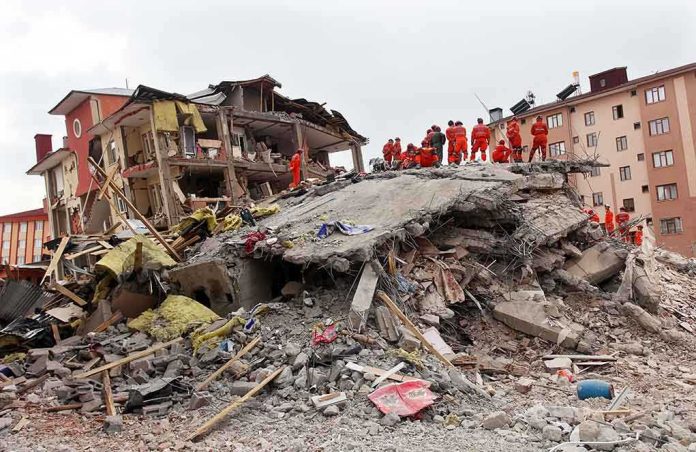
Residents of a small fishing settlement in Indonesia’s eastern Papua region heard what sounded like the front line of a war they never fought: a thunderous boom, a ball of flame, and a column of thick smoke rising from beneath a stilt house on a calm Sunday afternoon.[1][2] Police say five people were killed on the spot, around 19 others were injured, and three more are still listed as missing as rescuers comb through debris and scattered remains.[1][2] What looked like any other day by the water became, in seconds, a scene out of 1944.
The blast ripped through the wooden structure, then leapt to neighboring homes, leaving nine houses destroyed in a tight cluster of devastation.[1][2] Video from local broadcasters shows dazed villagers staring at charred pilings and twisted boards where families had been gathered moments earlier.[2] Police spokesman Cahyo Sukarnito told reporters the explosion came from beneath the house, not from a gas tank or cooking fire, which steered investigators quickly toward one grim possibility that people in the Pacific know too well.[1][2][3]
Police suspicion: a buried weapon from someone else’s war
Papua police did not mince words about their leading theory. The source of the blast is “strongly suspected” to be a bomb or mortar left over from World War II, according to Sukarnito’s statement to reporters.[1][2][3] Multiple outlets quote the same phrasing, and headlines around the world now describe a “suspected shell left over from World War II” detonating under that stilt house.[1][2] The language matters: this is not a claim of certainty, but it is a clear public attribution shaped by local history and the physical damage pattern at the scene.
Reporters describe a concentrated explosion, enough to obliterate one house, badly damage eight more, kill adults and children, and injure almost twenty villagers with blast and fragmentation.[1][2] That kind of focused destructive power, absent signs of a fuel depot or chemical storage, is consistent with a single medium-sized military munition rather than a random household accident. Common sense aligns with the police suspicion: if something behaves like a war shell buried in the dirt, people will call it a war shell until a technician can prove otherwise.
What we still do not know, and why the uncertainty matters
The public record still uses the word “suspected” for a reason. None of the reports so far describe bomb-disposal experts recovering identifiable fragments, measuring caliber, or reading markings that would pin the device to a specific army, year, or weapon system.[1][2][3] Police also say the investigation is ongoing and that they will update the public after the search for victims and technical work at the site are complete.[2][3] That means no independent forensic body has yet told the world, on the record, exactly what blew up under that house.
Even the trigger is unclear. Coverage notes the shell exploded under the structure and characterizes the event as likely accidental, but no one has publicly explained what set it off—whether it was a villager disturbing buried metal, children playing, a fire nearby, or simple corrosion reaching a fatal tipping point.[1][2] For people who instinctively distrust any quick official story, that gap fuels speculation about alternative causes, from criminal explosives to sabotage. Yet so far, no source presents positive evidence for any competing explanation; all the counterarguments rest on the absence of detailed proof, not on a different set of facts.
The wider legacy: World War II is still wounding the Pacific
This blast does not stand alone. The Pacific and Southeast Asia remain contaminated with leftover ordnance from some of the most intense naval and ground campaigns in modern history.[3] Historical analyses of ammunition ship explosions in Papua New Guinea and the Solomon Islands show that Allied ships like USS Mount Hood and USS Serpens carried massive quantities of bombs, shells, and grenades that often went up in catastrophic blasts.[3] When those ships and depots exploded, munitions rained into jungles, reefs, and harbors where no one mapped them carefully for future generations.
Decades later, farmers plow fields that were artillery positions, fishermen anchor boats where ammunition ships once burned, and children dig in sand that hides corroded steel packed with explosives.[3][4] In that context, a hidden munition under a stilt house in Papua is tragically plausible, not exotic. The uncomfortable truth for anyone who values order, responsibility, and limited government is that the bill for world-saving wars can arrive long after the victory parades end, and it is often paid by obscure families at the edge of maps.
Sources:
[1] Web – WWII Bomb Suddenly Explodes in Indonesia, Killing Five and Destroying …
[2] Web – Suspected World War II ordnance explodes in Indonesia, five dead
[3] YouTube – WWII-Era Bomb Explodes in Fishing Village, 5 Killed and 19 Injured …
[4] Web – Ammunition Ship Explosions in Papua New Guinea and Solomon …