

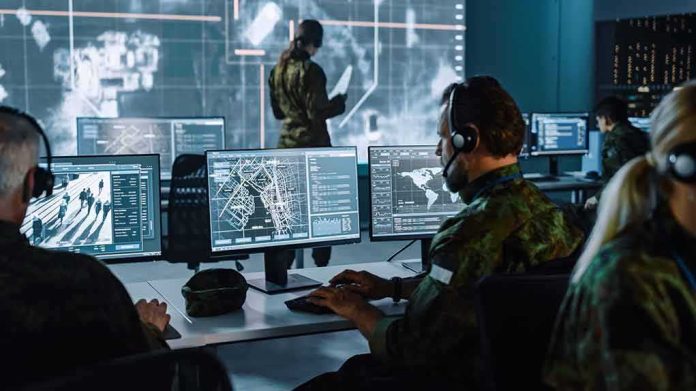
The Air Force Secretary publicly confirmed that the United States has space-control weapons already operating in orbit.
Story Snapshot
- Air Force Secretary Troy Meink said the U.S. has “on orbit, space-control weapons.”
- The remarks came at the Air, Space & Cyber Conference near Washington, D.C.
- Experts warn the disclosure could speed up a space arms race involving China and Russia.
- “Space-control” can include many tools, from jamming to satellite interceptors.
Public Confirmation Of On-Orbit Space Weapons
Air Force Secretary Troy Meink told an industry and military audience that the United States now has “on orbit, space-control weapons,” describing them as able to defend the joint force against hostile threats in space. The comments came at the Air, Space & Cyber Conference in National Harbor, Maryland, and marked one of the clearest public acknowledgments to date that such systems are deployed. Defense One reported that experts believe this disclosure could quicken a space arms race.
Armenpress also reported Meink’s message that the United States is developing and deploying counter-space systems to ensure superiority and control in space. That framing signals a focus on deterrence and protection of satellites that enable communications, navigation, and targeting for U.S. forces. The statement did not list specific systems or tactics. Officials often keep those details classified to preserve strategic surprise and to avoid tipping off potential adversaries.
What “Space-Control Weapons” Could Mean
Specialists use “space-control” to cover a wide range of tools that can deny, degrade, or defend space services. The Aerospace Corporation notes that space weapons can be Earth-to-space, space-to-space, or space-to-Earth, and can be kinetic or non-kinetic in effect. That means capabilities might include jamming, cyber tools, dazzling or blinding sensors, or physical interceptors. The term is broad by design, which is why official comments often stress the role of defense and deterrence.
United Nations-related work further explains that these systems aim to counter the benefits satellites provide, from data links to positioning and timing. Those benefits power much of modern life. They guide aircraft and ships, move bank transactions, and warn of storms. Any race to disable them raises risks for civilians and the economy, not just the military. Policymakers have warned that damage or debris from attacks can spread and harm many other satellites.
Why The Timing Matters For U.S. Strategy
Aviation Week reported that Meink said the United States did not start the push to weaponize space but is “pushing hard” to maintain control of that domain. His point echoes years of warnings about rapid Chinese and Russian advances in anti-satellite and counter-space programs. Prior leaders said that if rivals cannot beat the United States in the air, they will try to win in space, where blinding or disrupting networks could undercut U.S. power on Earth.
Iran Shot Down Another US MQ-1.
Drone Attacks Fishing Boats-Iran's Hormozgan.
Ansar Allah Takes Control of More Red Sea Islands.
Burnham Considers Request-Aid Saudi War in Yemen.
Ukraine & Russia To Halt Energy Attacks.
US Has 'On-Orbit' Space Weapons.https://t.co/ieBzVZVgiV— Gert Frobe (@GertFrobe72) September 15, 2026
Congressional hearing records also show interest in directed energy and other tools that can protect or disable targets without creating long-lasting debris. Lawmakers pressed witnesses on technologies that could defend U.S. assets and hold hostile systems at risk. These discussions, paired with Meink’s statement, show a government posture that seeks credible deterrence. The goal is to convince rivals that attacks on space systems would fail or invite rapid response.
Shared Concerns Beyond Partisan Lines
Americans across the spectrum worry that elite decisions in secret put national security and the economy at risk. This disclosure confirms what many suspected: space is now an active military front. The upside is deterrence that can protect satellites that power phones, maps, markets, and emergency alerts. The downside is a faster arms race above our heads. Clear rules, modern defenses, and honest oversight will matter as much as the hardware to keep citizens safe.
Sources:
defenseone.com, armed-services.senate.gov, armenpress.am, war.gov, migflug.com, airuniversity.af.edu