
Three firefighters dying in a “burnover” on the Colorado‑Utah border has many Americans asking whether the people we trust to manage growing wildfire dangers are learning from past mistakes or repeating them in silence.
Story Snapshot
- Three federal firefighters were killed and two injured in a burnover on the Snyder wildfire complex along the Colorado‑Utah border.[3]
- The blaze has burned about 28,000 acres with 0% containment, as dozens of fires rage across the drought‑stricken Southwest.[3][9]
- Officials praise “bravery and sacrifice,” but have released few details on what went wrong or how the crew was trapped.[2][9][14]
- The case fits a longer pattern where deadly entrapments get a quick official label but slow, quiet accountability.[5][6][18]
Deadly Burnover on the Snyder Fire Complex
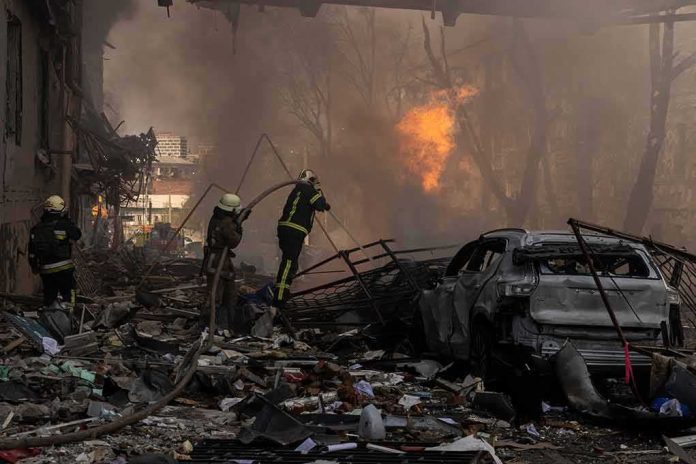
Three federal firefighters were killed Saturday in Mesa County, Colorado, when a wind‑driven wildfire overran their position on the Snyder fire complex near the Colorado‑Utah border.[3] Two other firefighters survived but suffered burn injuries and are being treated, with officials giving no public detail about their condition beyond that.[2] The U.S. Wildland Fire Service says the crew was part of an interagency response working the Knowles and Gore fires when flames suddenly trapped them in what is called a “burnover” incident.[2][9]
Officials report that the Snyder fire began as smaller lightning‑started blazes, including the Snyder Mesa Fire in eastern Utah’s Grand County, before flames crossed the border and merged with the Jones, Knowles, and Gore fires.[1][3] As the fires combined, high winds and very dry land helped the complex expand quickly across rugged canyons and conservation areas west of Fruita and Grand Junction.[3] The U.S. Department of the Interior and the new Wildland Fire Service have not yet released the names or home stations of the fallen firefighters, saying families must be notified first.[1][2]
Exploding Wildfires and Emergency Response
By Sunday morning, federal land managers estimated the Snyder Fire at more than 28,000 acres with 0% containment, meaning no part of the fire’s edge is firmly under control.[3] Fire behavior has been driven by strong winds and drought‑parched fuels, the kind of conditions that can cause sudden, extreme spread that outpaces crews on the ground.[3][9] At the same time, a separate Cottonwood Fire in southwest Utah ballooned to well over 140 square miles, destroying part of a ski resort and summer cabins and adding to the sense of a regional wildfire crisis.[2][9]
Colorado Governor Jared Polis declared a disaster emergency on Saturday, authorizing the Colorado National Guard to support the Snyder response and other nearby fires threatening communities in Mesa County.[1][3] Evacuation warnings have gone out for smaller communities as officials warn residents to be ready to leave quickly if winds push flames toward homes.[1] A Complex Incident Management Team is scheduled to take command of the Snyder Fire, a sign that authorities see this as a long, high‑risk fight that needs extra coordination.[3] Many citizens see these moves as necessary, yet they also worry that fast declarations and military support do not answer deeper questions about safety and planning.
Entrapment, “Burnover” Narratives, and Accountability
Wildland fire experts use the word “entrapment” when firefighters are suddenly caught in a life‑threatening position where their planned escape routes or safety zones no longer work.[15][16] In this incident, officials quickly labeled the deaths a “burnover,” meaning flames swept over the crew before they could reach safety, echoing language used after past tragedies like the South Canyon Fire in 1994.[6][15] Research shows a recurring pattern since the 1990s: agencies often issue fast statements about burnovers, honor the dead, and promise investigations, while detailed meteorological logs, terrain analysis, and tactical reviews come much later with little public debate.[14][18]
Update on a few of the FIRES in Utah
as of 06/28/2026.Cottonwood FIRE /
the largest active wildfire in the USA
is Burning near Beaver
in the Fishlake National Forest
&
has swollen to 93,607 acres
&
remains at 0% containment.Thus far it has destroyed numerous…
— Linda Uselman (@UselmanLinda) June 29, 2026
Many Americans across the political spectrum are frustrated with that pattern. They hear praise for “bravery, dedication, and sacrifice” from federal agencies and see solemn honors on television, yet they rarely see clear answers about whether bad planning, poor equipment, or avoidable risk played a role.[2][16] Official guidance for investigating entrapments stresses the need to secure the scene, collect photos of burn patterns, document travel routes, and conduct thorough team reviews to capture lessons and change training.[14][16] When the public is only told a crew was “overcome by fast‑moving flames,” without specific findings, it can feel like the same system failures are allowed to repeat while leaders focus on public relations instead of hard fixes.
Shared Concerns about a System Under Strain
Conservatives who already distrust big government see this tragedy as one more sign that distant agencies and “deep state” managers are not protecting the people on the line or the communities in harm’s way. Liberals who worry about climate‑driven disasters and the growing gap between rich and poor see working‑class firefighters taking deadly risks while wealthier decision‑makers remain safely removed. Both groups point to the same basic fear: powerful institutions talk about heroism during crises but avoid honest, fast accountability when something goes wrong on their watch.
Studies of U.S. wildland firefighter entrapments find important trends and repeated safety issues, yet these findings are rarely explained in plain language to the public.[18][19] Experts have identified dozens of common hazards on the fire line, from failed escape routes to breakdowns in communication, that can lead to burnovers like the one on the Snyder Fire.[19][20] As the West faces hotter, drier conditions and more intense wildfire seasons, citizens on the right and left are asking not just how many acres are burning but whether the people running the response are learning quickly enough to keep crews alive. Until detailed, transparent findings from this entrapment are shared, the sense that the system is failing ordinary Americans will only grow.
Sources:
[1] Web – 3 firefighters killed, 2 injured while tackling wildfires on the …
[2] Web – Three Firefighters Killed, 2 Injured in Snyder Wildfire on Utah …
[3] Web – 3 firefighters killed responding to Snyder wildfire on Utah-Colorado …
[5] X – Three firefighters died and two were injured while tackling fires on …
[6] Web – Three firefighters killed, 2 injured in Snyder wildfire on Utah …
[9] Web – 3 firefighters killed, 2 injured battling wildfires on Colorado-Utah …
[14] Web – Three firefighters killed while tackling major wildfires along …
[15] Web – [PDF] Investigating Wildland Fire Entrapments
[16] Web – [PDF] Wildland firefighter entrapment avoidance: modelling evacuation …
[18] Web – Predicting Firefighter Injury and Entrapment in Urban … – PMC – NIH
[19] Web – A review of US wildland firefighter entrapments: trends, important …
[20] Web – 21 issues identified in firefighter entrapment during wildfires.