

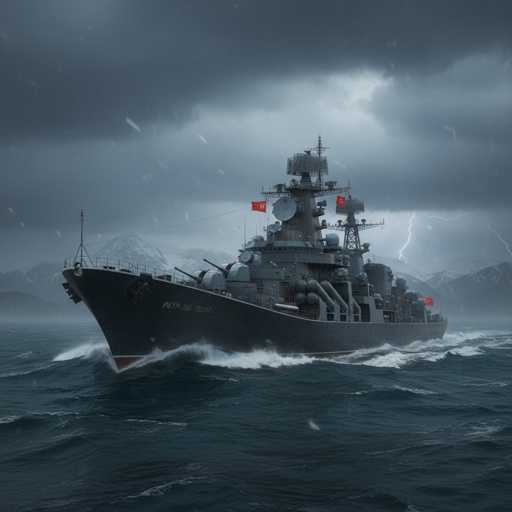
A massive Russian nuclear warship is steaming toward the Arctic bastion, and it is built to guard hidden nuclear submarines that could one day target the United States.
Story Snapshot
- Russia’s nuclear-powered battlecruiser Admiral Nakhimov, the world’s largest surface combat ship, is entering final Arctic-focused trials.
- The ship is meant to shield Russia’s nuclear missile submarines that form the backbone of its second-strike nuclear force in the Arctic.[15]
- Western analysis says the ship is powerful but vulnerable, and not a true “war‑winning” game‑changer for the region.[2]
- NATO still holds key advantages in undersea warfare, air power, and surveillance across the High North.[2]
Russia’s Giant Nuclear Warship and the Arctic Nuclear Chessboard
Russian commanders are bringing the nuclear-powered battlecruiser Admiral Nakhimov back into front-line duty after one of the longest and most expensive ship refits in modern naval history.[4] This Kirov-class giant displaces around 28,000 tons when fully loaded, making it the largest nuclear-powered surface combat ship in the world and larger than many aircraft carriers fielded by medium powers.[2][4] Nuclear propulsion gives it almost unlimited range at sea and is tailored for long missions in harsh Arctic conditions where fuel logistics are difficult.[1]
The Arctic is not just ice and polar bears; it is one of the main routes for Russian nuclear forces aimed at North America. Russia’s Northern Fleet operates ballistic missile submarines that carry hundreds of nuclear warheads and sit at the core of Moscow’s second-strike nuclear strategy.[13][15][16] Analysts describe the Arctic around these submarines as a “bastion,” heavily defended territory Russia wants to seal off from North Atlantic Treaty Organization (NATO) submarines, aircraft, and surface ships that could threaten its nukes.[12][15]
Missiles, Air Defense, and What This Ship Can Really Do
Admiral Nakhimov is being armed as a floating missile arsenal, with modern vertical launch cells for Kalibr land-attack cruise missiles, Oniks anti-ship missiles, and hypersonic Zircon missiles.[2][4] Estimates suggest around eighty universal launch cells for these strike weapons, which could reach targets 1,500 to 2,500 kilometers away, slamming into ships or land bases with very little warning.[2][4] For American and allied vessels in the Norwegian Sea or North Atlantic, a coordinated Zircon strike would make missile defense far harder and reaction times much shorter.[2]
The ship is also built as a high-end air defense platform. Reports and official statements indicate it will field ninety‑six long-range surface-to-air missiles derived from the S‑400 family, under the naval Fort-M system, plus several close-in Pantsir-M defenses.[1][4] This network is designed to create a wide shield against aircraft, drones, and cruise missiles and to protect nearby ships and submarines from air attack.[1][2][4] Russian planners expect Admiral Nakhimov to work with submarines, satellites, maritime patrol aircraft, and MiG‑31 interceptors to build a real-time picture of the Arctic battlespace.[1][15]
Why Analysts Say It Is Powerful but Not a “War-Winner”
Despite its firepower, independent Western analysts warn that Admiral Nakhimov does not suddenly flip the balance of power in the High North.[2] The ship is labeled a “powerful but vulnerable component,” not a war-winning tool that can dominate NATO at sea.[2] One key weakness is under the waterline. French defense analysis notes the cruiser is poorly equipped with modern anti-submarine sensors and cannot reliably detect or counter new-generation nuclear or diesel-electric submarines hunting in the same Arctic waters.[4]
That shortfall matters because NATO’s strongest tools in the Arctic include advanced attack submarines, long-range maritime patrol aircraft, and integrated surveillance networks.[2][5][17] Those systems are built to track and, if war comes, destroy Russian submarines and surface groups trying to operate from the Arctic into the North Atlantic.[12][15] Even with its upgraded missiles and radars, Admiral Nakhimov cannot erase NATO’s advantage in undersea warfare and intelligence, which still shapes the real balance of risk in the region.[2][5]
Long Delays, Reliability Questions, and What It Means for America
Admiral Nakhimov’s story also shows the limits of Russian shipbuilding. The cruiser has been under modernization since the late 1990s, with work effectively stretching for more than twenty-five years, and its return to service has slipped several times from early dates like 2022 to mid‑2020s timelines.[3][4] Such delays raise questions about cost, build quality, and how often the ship will actually be available for operations, especially in harsh Arctic waters that punish even new hulls.[3]
For American readers, the message is twofold. First, Russia is serious about hardening its Arctic nuclear shield and signaling that it can threaten sea lanes and even the U.S. homeland from the north with advanced cruise and hypersonic missiles.[12][15] Second, NATO, led by the United States, still has the stronger hand if we keep investing smartly in submarines, Arctic airfields, and cold-weather training for our forces.[5][14][17] Clear eyed, steady policy can counter Russian moves without panic, but it requires focus on defense, not on woke distractions or wasteful spending at home.
Sources:
[1] Web – The World’s Only Nuclear-Powered Warship That Isn’t a Carrier Is …
[2] YouTube – Russia’s Arctic Monster Awakens: Putin’s 28000-Ton War Giant Is Back
[3] Web – Is the Admiral Nakhimov a danger to NATO in the Arctic?
[4] Web – Russian battlecruiser Admiral Nakhimov – Wikipedia
[5] Web – [PDF] the return of admiral nakhimov and its significance to russian …
[12] Web – [PDF] (U) Russia’s Military Build‐Up in the Arctic: to What End? – …
[13] Web – [PDF] The Kremlin’s Arctic Dreams. Geo-Strategic Implications for …
[14] Web – Chapter 4: Russia and the Arctic: High Ambitions, Modernized …
[15] Web – The Impact of the Post-Arms Control Context and Great Power …
[16] Web – Will the Arctic be the Most Likely Flashpoint for a Nuclear War?
[17] Web – THE ICE CURTAIN: RUSSIA’S ARCTIC MILITARY PRESENCE – CSIS