

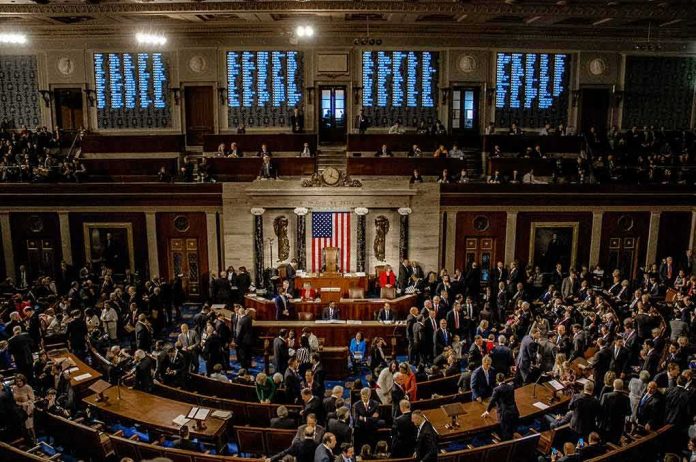
Congress just fired a symbolic shot at President Trump’s Iran strategy, raising serious questions about who controls America’s war powers under the Constitution.
Story Snapshot
- Senate and House passed a concurrent war powers resolution telling Trump to halt military action against Iran.
- The vote was narrow but bipartisan, with four Republicans joining Democrats amid concern over war costs and casualties.
- The resolution orders withdrawal from hostilities unless Congress gives clear authorization, but it likely has limited legal force.
- The White House says the War Powers Act is unconstitutional and insists Trump can act under his own Article II powers.
Congress Moves to Curb Trump’s Iran War
The United States Senate voted 50–48 to approve a war powers resolution that directs President Donald Trump to halt United States military action against Iran, matching a measure the House passed earlier in June.[1][7] This conflict began on February 28 and has become deeply unpopular, even among some Republicans who had previously backed the president’s foreign policy.[1][2] Reports say the war has cost about $100 billion and led to the deaths of at least 13 American service members, with over 360 injured, adding pressure to reassess the mission.[19] Lawmakers framed the vote as a demand that Congress regain its constitutional say over war.
This resolution is a concurrent measure under the 1973 War Powers Act, sometimes called the War Powers Resolution, which was passed over President Richard Nixon’s veto to check unilateral wars like Vietnam.[18] Under that law, Congress can direct the removal of United States forces from hostilities without sending a bill to the president for signature, which is why this resolution does not go to Trump’s desk.[1][21] The text instructs the president to withdraw United States forces from hostilities involving Iran unless Congress passes a specific authorization or declares war, echoing the statute’s 60-day limit on unauthorized combat deployments.[7][18] Supporters say this is a constitutional reminder that only Congress can authorize an offensive war.
A Rare Bipartisan Rebuke, But Mostly Symbolic
The House of Representatives passed its Iran war powers resolution 215–208, with four Republicans joining Democrats to back the measure.[19] In the Senate, four Republicans also crossed party lines and voted with nearly all Democrats, while John Fetterman, a Democrat from Pennsylvania, opposed the resolution and backed Trump’s broader war authority.[19] This made the vote a rare bipartisan rebuke of a sitting president’s handling of an ongoing war.[6] Yet most outlets, even those critical of Trump, describe the move as largely symbolic because concurrent resolutions generally do not carry full force of law and cannot directly compel a commander in chief to change course.[6][7] Without a binding joint resolution and enough votes to override a veto, Trump’s legal power over the campaign remains mostly intact.
The White House responded by dismissing the Senate vote as meaningless and insisted that the War Powers Act itself is unconstitutional.[3] A senior official argued that the resolution “has no significance” and only passed because two Republicans were absent from the chamber during the vote.[3] The administration also claimed the measure orders removal from hostilities that they say already ended with a ceasefire on April 7, suggesting Congress is fighting yesterday’s battle.[3][4][5] Legal analysts note that if Trump treats the War Powers Act as nonbinding, it deepens a long-running clash over whether presidents can wage major military campaigns based only on Article II powers, without fresh authorization from Congress.[9][10][22]
War Powers Act and the Fight Over Article II Authority
The War Powers Resolution of 1973 requires presidents to notify Congress within 48 hours of sending troops into combat and to end those hostilities within 60 days, plus 30 days for withdrawal, unless Congress declares war or passes an authorization for use of military force.[18][9] Congress wrote this law to force transparency and to stop “wars of choice” launched by the executive branch without democratic debate.[16][20] However, every president since has pushed back by claiming broad inherent authority under Article II of the Constitution to use force abroad when they say national interests are at stake.[9][22] The Trump administration’s Iran campaign fits this pattern, relying on independent constitutional authority rather than the post‑9/11 authorizations that justified earlier Middle East wars.[9]
Here I’ll write what I think of GLUTTONOUS GENOCIDAL COCKROACH 🪳 NETANYAHU who’s greed supersedes all past generations of Murderers like #HITLER with US Presidents blessings in tow. They Create hateful wars and steal the Oil and Lands at the behest of PSYCHOPATH Netanyahu… pic.twitter.com/odb6lZ1DHX
— @PrincessBibiRF_ (@PrincessBibiRF2) June 20, 2026
The Senate’s action also follows earlier failed attempts to rein in Trump’s war powers. In 2025, a similar Iran resolution was blocked, and another measure aimed at limiting operations against Venezuela also narrowly failed, showing how hard it is to gather enough votes to truly bind a president.[19][8] Analysts explain that even if Congress passed a joint war powers resolution and sent it to the White House, Trump could veto it, and lawmakers currently lack the two‑thirds majorities in both chambers needed to override.[8][19] This means Congress’s main leverage is political, not legal: public hearings, high‑profile votes, and funding fights that raise the price of keeping troops in harm’s way.[21] For citizens who care about the Constitution and the cost of endless war, these votes are a warning flare, not yet a hard brake on the conflict.
Sources:
[1] YouTube – US Senate votes to halt Iran war in latest rebuke of Trump
[2] Web – House passes resolution to end hostilities with Iran – NPR
[3] Web – The war powers resolution on the Iran war: What’s next? – PolitiFact
[4] YouTube – Senate Republicans vote down war powers resolution amid Iran …
[5] Web – US House passes Iran war powers resolution in rare pushback …
[6] Web – Roll Call Vote 119 th Congress – 2 nd Session – Senate.gov
[7] Web – House votes to block Trump from ordering more strikes on Iran
[8] Web – House to vote on Iran war powers resolution – Facebook
[9] Web – Iran War Powers resolution heads to the Senate | FOX 5 Atlanta
[10] Web – The Law of Going to War with Iran, Redux | Lawfare
[16] Web – In rebuke of Trump, House passes war powers resolution aimed at …
[18] Web – Findings and Analysis | War Powers Resolution Reporting Project
[19] Web – What’s next for the War Powers Resolution on Iran? PolitiFact explains
[20] Web – War Powers | Brennan Center for Justice
[21] Web – [PDF] Ballotbox Diplomacy: The War Powers Resolution and the Use of …
[22] Web – War Powers and the Return of Major Power Conflict