

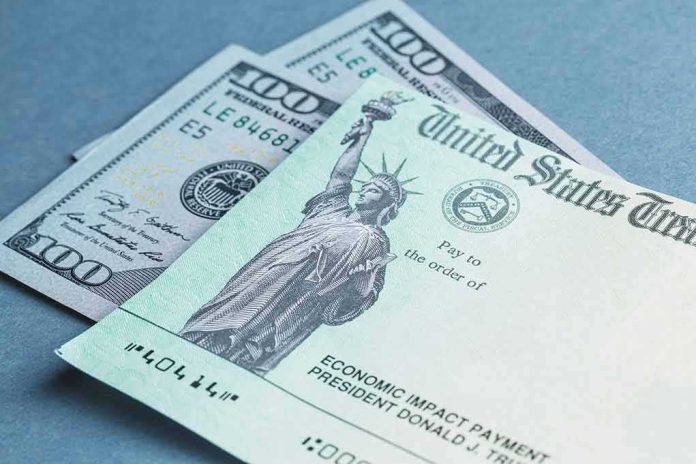
Trump has put his own signature on a mock-up of the $100 bill, and the image instantly turned a currency design into a fight over power, history, and trust.
Quick Take
- Trump posted the first public image of a redesigned $100 note on Truth Social.
- The Treasury Department said his signature will appear on future paper currency to mark the 250th anniversary of the United States.
- Reuters reported that the new notes are set to be printed in June 2026, with Trump’s signature and Treasury Secretary Scott Bessent’s signature.
- The announcement would end a 165-year tradition tied to the U.S. Treasurer’s signature.
Trump Shows the New Image
Trump’s post gave the public its first look at a redesigned $100 bill that appears to carry his signature. People.com reported that the image spread quickly because it showed a sitting president tied to American currency in a way that had never happened before. That alone made the story bigger than a simple design reveal. It touched a nerve about who gets to shape national symbols, and why those symbols are changing now.
The Treasury Department had already announced that Trump’s signature will appear on future U.S. paper currency. The department said the change is meant to honor the 250th anniversary of the United States and will place the president’s signature alongside the Secretary of the Treasury’s signature. Reuters said the new bills will be printed in June 2026 and will also end the long-standing use of the U.S. Treasurer’s signature.
What the Government Has Confirmed
The official Treasury statement matters because it confirms this is not just a social media stunt. It says the signature change is real and tied to future paper currency, not only to one image online. Reuters reported that this marks the first time a sitting president’s autograph will appear on American money, ending a 165-year tradition. That makes the move a notable break from how U.S. currency has been handled for generations.
At the same time, the public record still leaves some gaps. The Treasury release does not clearly say whether the signature will be a facsimile or a direct autograph. It also does not give a firm date for when the bills will reach general circulation beyond the June printing plan. So the core announcement is real, but the rollout details remain limited.
Why the Story Draws Bigger Attention
This story lands in the middle of a broader fight over government image, money, and trust. Supporters see a historic first tied to the country’s semiquincentennial. Critics see another example of a president pushing personal branding into national institutions. Those tensions are not new, but they are sharper when the subject is the dollar bill, one of the most familiar symbols in daily life.
President Donald Trump unveiled the design for a redesigned $100 bill featuring his signature alongside Treasury Secretary Scott Bessent's, marking the first time in U.S. history a sitting president's signature is featured on paper currency.
— Leinona Aoki (@LeinonaA69) July 5, 2026
The reaction also reflects a wider climate of doubt around high-profile Trump-linked projects. Separate reporting on Freedom 250 has raised questions about transparency, donor pressure, and access tied to commemorative efforts around the 250th anniversary. Those disputes are not the same as the currency change, but they feed a broader public suspicion that big patriotic projects can become political tools. That is why this $100 bill image is being read as more than a design choice.
What Still Needs Verification
Even with the Treasury announcement, one important issue remains: the public has not been shown an official high-resolution specimen of the finished bill. That leaves room for questions about the exact layout, security features, and production method. For now, the strongest verified facts are simple. Trump posted the image, Treasury confirmed the signature plan, and the change would break a long-standing currency tradition.
The larger significance is that the image has become a test of public confidence. If the bill enters circulation as described, it will be remembered as a first in U.S. history. If more details emerge, they will matter because currency is supposed to feel stable, not political. In that sense, the story is not only about Trump’s signature. It is also about how much institutional change people will accept before they stop trusting what they hold in their hands.
Sources:
facebook.com, people.com, reuters.com, x.com, youtube.com