

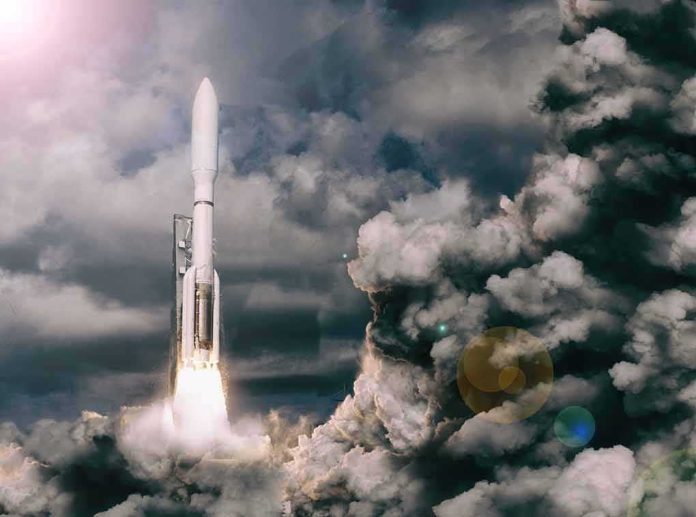
United Launch Alliance confirmed its Vulcan rocket failed to deliver 40 Amazon internet satellites to orbit after an in-flight anomaly about 10 minutes into launch.
Story Snapshot
- United Launch Alliance reported an anomaly and a failed delivery to orbit during Amazon’s Leo 1 mission.
- The November 15 launch from Cape Canaveral carried 40 satellites for Amazon’s broadband network.
- Cause of the failure was not identified in initial statements; an investigation is expected.
- The incident underscores known launch risks that insurers price into coverage for early mission phases.
What ULA Said About The Failure
United Launch Alliance said the Vulcan rocket launched from Space Launch Complex 41 at Cape Canaveral on November 15 and “suffered an anomaly” about 10 minutes into flight. The company said the mission “failed to deliver the Amazon mission to orbit.” That statement confirms the timing and outcome but does not name a cause. United Launch Alliance also noted it lacked specific data right after the event, which is common in early post-flight updates.
Reports from multiple outlets matched the basic details. Coverage identified the payload as 40 low Earth orbit satellites for Amazon’s planned broadband network. Stories described the event as a return-to-flight launch that ended without the payload reaching orbit. These reports aligned on the date, the Cape Canaveral site, and the rough 10-minute timeline. The consistent details across outlets support confidence in the core facts while the technical reason remains under review.
What We Know And What We Do Not
The record supports these facts: the rocket lifted off, an anomaly occurred about 10 minutes later, and the payload was not delivered to orbit. The available reports do not show telemetry or a subsystem fault, and they do not confirm the physical condition of each satellite. That means the fate of individual units is not publicly documented. United Launch Alliance’s next steps usually include data review and a formal mishap inquiry before any design or process changes.
Some prelaunch coverage noted earlier issues with a booster nozzle on prior Vulcan flights and said a redesigned part was flying. That background can frame public debate, but it does not prove cause-and-effect for this failure. Mixing past component issues with this event would go beyond the evidence. Clear separation between known facts and open questions helps avoid error while the company and regulators analyze what went wrong.
Why This Matters For Internet From Space
Amazon is building a large satellite fleet to provide internet service. This launch was reported as the first of many planned Vulcan missions under a broad contract. A failed delivery can ripple through schedules, insurance, and replacement plans. It can also influence how quickly a company can offer service. Large constellation projects depend on steady launch cadence. Any pause for investigation can extend timelines and raise short-term costs for partners and customers.
Insurance experts have long treated launch and the first months in space as the riskiest phase for satellites. Policies often cover “launch plus one year” because most catastrophic losses occur at liftoff, during ascent, or early on-orbit operations. Underwriters look at vehicle track records, provider processes, and mission specifics. They model the real chance of failure and price coverage accordingly. This event fits that risk profile rather than an unseen outlier in spaceflight history.
The Broader Launch Risk Picture
Commercial launch is safer than decades ago, yet failures still happen. Government hazard reviews have shown that expected failure rates for commercial rockets are not zero, and risk planning is part of every license and mission. Investors, insurers, and customers know this. The key questions now are what failed, how quickly United Launch Alliance can fix it, and how Amazon adjusts its deployment plan while keeping costs and schedules in check.
ULA says its Vulcan rocket suffered an anomaly 10 minutes into Sunday's flight and failed to put 40 Amazon Leo satellites in orbit. Reuters and CBS News report it is ULA's first mission failure since its 2006 founding. No cause has been announced.
Sources: ULA, Reuters, CBS News https://t.co/6GCnI5tmiR pic.twitter.com/VO5uPZXLfV— Omer (@FactReelHQ) November 16, 2026
For many readers, this incident also touches a wider frustration. People see giant firms and complex government rules in space, yet basic promises at home feel out of reach. Space should serve people on the ground, not just boardrooms. Clear answers, transparent fixes, and fair competition can help restore trust. This is not about left or right. It is about whether powerful players deliver results and own mistakes when things go wrong.
Sources:
cbsnews.com, spaceflightnow.com, orlandosentinel.com, perthnow.com.au, space.com, faa.gov